About Amazona oratrix Ridgway, 1887
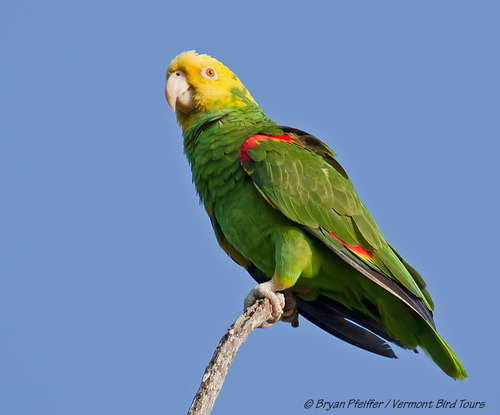
The yellow-headed amazon (Amazona oratrix Ridgway, 1887) averages 38–43 centimetres (15–17 in) in length. It has the body shape typical of amazon parrots: a robust build, rounded wings, and a square tail. Its body plumage is bright green, with yellow markings on the head, dark scalloped markings on the neck, red coloring at the bend of the wing, and yellow thighs. The flight feathers range from blackish to bluish violet, with a red patch on the outer secondaries. The base of the tail also has a red patch, which is usually hidden, and the outer tail feathers have yellowish tips. The bill is horn-colored (gray), and it is darker in immature individuals of the Belizean subspecies. The bare eye ring is whitish in Mexican populations and grayish in other populations. The most noticeable difference between populations from different geographic regions is the amount of yellow plumage. In adult birds, the head and upper chest are yellow in the Tres Marías Islands subspecies (tresmariae); only the head is yellow in the widespread Mexican subspecies (oratrix); only the crown is yellow in the Belize subspecies (belizensis); and only the crown and nape are yellow in the Sula Valley of Honduras subspecies (hondurensis), which gives it a resemblance to the yellow-naped parrot. Immature birds have less yellow plumage than adults, and they develop full adult plumage between 2 and 4 years of age. The selectively bred variety "Magna" (or "Magnum") is developed to have more yellow plumage, and sells for a higher price as a pet. Some "extreme" Magnas have as much yellow plumage as wild Tres Marías Islands birds, but can be distinguished from the wild subspecies by heavier barring on the chest and a less bluish tint to the green body plumage. Wild yellow-headed amazons produce low-pitched, sometimes human-sounding screams, but often fly silently, which differs from the behavior of many other parrot species. Their calls have been described as "a rolled kyaa-aa-aaah and krra-aah-aa-ow, a deep, rolled ahrrrr or ahrhrrrr," among other variations. Young birds make a "clucking" sound to signal that they are hungry. This species lives in riparian forest, areas with scattered trees, evergreen forest in Belize, and mangroves in Guatemala. It occurs in the Belizean pine forests ecoregion, which is a notable area of its occurrence. It can be found singly, in pairs, in small groups, and occasionally in large flocks. Its former native range included both coastal slopes of Mexico from the Tres Marías Islands and Jalisco to Oaxaca, and from Nuevo León to northern Chiapas and southwestern Tabasco, as well as a separate disjunct area covering most of Belize, and another disjunct area covering a small part of northeastern Guatemala and northwestern Honduras. However, the species’ population has declined drastically: it dropped by 90% to 7,000 individuals between the mid-1970s and 1994, and by an additional 68% between 1994 and 2004, driven by capture for the pet trade and habitat destruction. Introduced populations exist in Stuttgart, Germany, where a current population of over 50 individuals lives. Smaller introduced populations are found in coastal neighborhoods of San Diego, California, including Coronado, Ocean Beach, Pacific Beach, Point Loma, La Jolla, and Imperial Beach; they also occur in Santa Ana, Loma Linda and Pasadena, all in Southern California. Additionally, introduced and apparently breeding populations have been reported in Puerto Rico.