About Amazona leucocephala (Linnaeus, 1758)
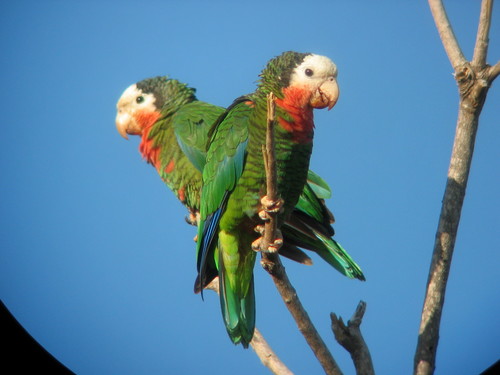
The Cuban amazon, with the scientific name Amazona leucocephala (Linnaeus, 1758), is a medium-sized parrot that measures 28–33 centimetres (11–13 in) in length. Its plumage is mainly green, with some blue feathers on its wings. Each green feather has a terminal black rim along its edge. The lower face, chin, and throat are rosy pink, while the forehead and eye-rings are white. The extent of the head’s various color patches, the amount of rosy pink on the upper chest, and the amount of dull red on the abdomen all differ between subspecies. This parrot has pale olive-green irises, a horn-coloured beak, blackish feathers over the ears, and pink legs. Juvenile Cuban amazons have little to no red on the abdomen, less black edging on their green feathers, and some feathers on the top of their head may be pale yellow instead of white. This species occupies different habitats across different islands. It was originally found across the whole of Cuba, but now it is mostly restricted to forested areas of Cuba’s main island and Isla de la Juventud. The total Cuban population is around 10,000 individuals, with an estimated 1,100–1,320 individuals on Isla de la Juventud. On the Cayman Islands, the parrot inhabits dry forest and agricultural land. A 2006 survey counted around 3,400 individuals on Grand Cayman, and the population on Cayman Brac numbers 400–500 individuals. The Little Cayman population was extirpated in the 1940s. 2006 population estimates recorded 3,550 individuals on Abaco and 6,350 on Inagua. The populations on Acklins and Crooked Islands were extirpated in the 1940s. Fossil remains and archeological findings show that the Cuban amazon was also historically present on several other Bahamian islands, including New Providence and San Salvador, as well as on Grand Turk Island.