About Amazona finschi (P.L.Sclater, 1864)
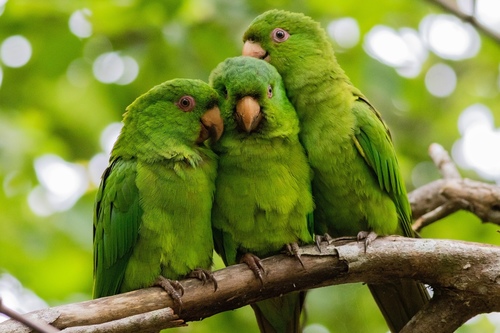
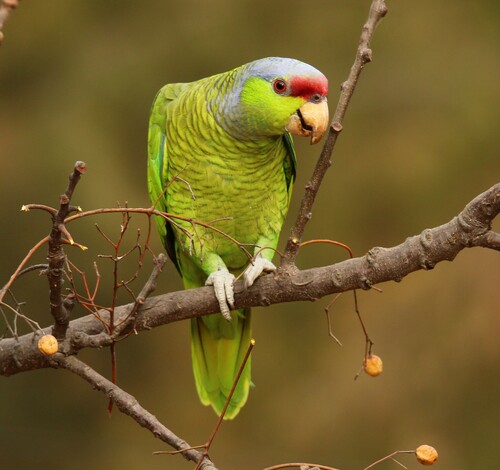
The adult lilac-crowned amazon (Amazona finschi) has primarily green plumage, with yellowish underparts and black edging across most feathers. Its forehead is maroon, while its neck, nape, and crown are a light blue-lilac shade. The cheeks and ear coverts are greenish yellow, with none of the black edging seen on most of the bird’s plumage. Primary flight feathers are dark blue, and secondary flight feathers are green with dark blue tips. The first five secondary feathers have a bright red speculum along their edges. The wing coverts, underside of the flight feathers, and tail are all green; the tail is tipped with a yellowish coloring matching that of the cheeks and ear coverts. The beak, orbital rings, and legs are pale brown-grey, and adult irises are amber-colored. Juvenile lilac-crowned amazons look very similar to adults, with only two key differences. Juveniles have dark brown irises instead of the amber color seen in adults, and they have far fewer maroon feathers on the forehead. Juveniles begin developing adult plumage and eye color after around one year of age. This parrot is endemic to the Pacific coast of Mexico, where its range extends from southeastern Sonora and southwestern Chihuahua down to southern Oaxaca. In Sinaloa and northern Nayarit, its range sits above 375 meters elevation; it only reaches sea level starting in southern Nayarit, and stays at lower elevations through Jalisco and Oaxaca. The lilac-crowned amazon’s natural Mexican habitat is under threat, and population declines have been recorded across almost all of its natural range. Data and resident accounts show the species’ total population range has shrunk by 20% due to habitat loss. An increasing population of approximately 100 individuals lives in Southern California, concentrated particularly in the San Gabriel Valley and Orange County. This observed increase may be due to more reliable population counting methods than were used in past years. The California population is most often found in residential areas. Occasionally, it forms mixed nesting groups with red-crowned parrots, in either native conifer forests or areas with non-native captive-grown plants.