About Amazona farinosa (Boddaert, 1783)
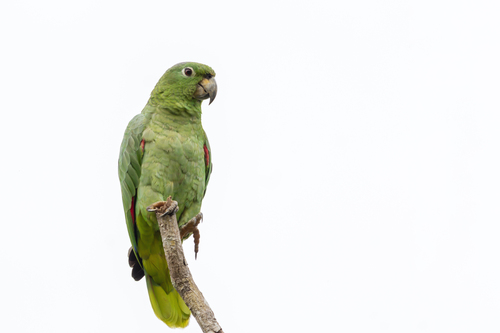
The mealy amazon, with the scientific name Amazona farinosa (Boddaert, 1783), has a total length of about 38–41 cm (15–16 in) and weighs 540–700 g (19–25 oz); captive individuals commonly weigh more. It is among the largest parrots native to the Americas, and only large macaws typically surpass it in size. Like other members of the Amazona genus, it has a relatively short, square-shaped tail. Its plumage is mainly green, and the back and nape often carry a whitish tinge that resembles a thin layer of flour, or meal — this appearance is how the species got its common name. The distal half of its tail is paler and more yellow than the basal half, giving the tail a distinctly two-colored appearance. When in flight, the bird shows a bluish-black trailing edge along its wing and a noticeable red speculum. Occasionally, a small number of yellow feathers can be seen on the top of its head. In South America, it is often confused with the yellow-crowned amazon. The mealy amazon can be distinguished from that species by its larger size, the reduced amount of yellow on its crown (this trait is not entirely reliable, as some yellow-crowned amazons may have almost no yellow on the crown), the whitish tinge to its plumage, a broader white eye-ring, and the placement of the red coloring on the wing's leading edge near the phalanx rather than near the radiale. This last distinguishing feature is often difficult to see, especially on perched birds. The two species also have strikingly different voices. The mealy amazon is found in tropical Central America and South America. It most often lives in humid to semi-humid forest and plantations, and only rarely occurs in deciduous forest. In regions dominated by open or dry habitats, it is restricted to gallery forest, or not present at all. The diet of the mealy amazon is made up mostly of fruits, seeds, berries, nuts, blossoms, and leaf buds.