About Amazona brasiliensis (Linnaeus, 1758)
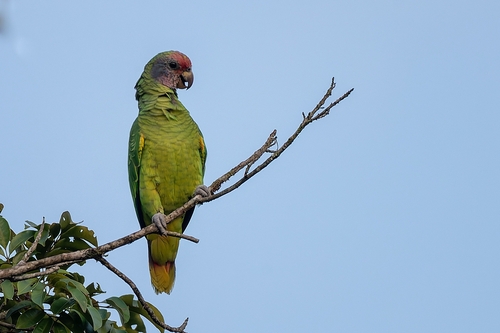
The red-tailed amazon, Amazona brasiliensis, weighs around 425 g (15.0 oz) and measures approximately 35 cm (14 in) long. As its common name suggests, the species has a broad red band on its tail. This band is mostly limited to the inner webs of the tail feathers, so it is mainly visible from below or when the tail is spread open. The tail also has a broad yellow tip, and the outer tail feathers (rectrices) are dark purplish-blue at their base. Most of the bird's plumage is green. The throat, cheeks and auricular feathers are purple-blue, the forecrown is red, and all rectrices have a broad dark blue tip. The bird has a yellowish bill with a blackish tip on the upper mandible, a pale gray eye ring, and orange irises. Juveniles have duller plumage and brown irises. The red-tailed amazon is native to the Serra do Mar coastal forests. This species is almost entirely restricted to lowlands, and typically occurs at altitudes below 200 meters (660 feet) above sea level, though it may sometimes reach altitudes up to 700 m (2,300 ft). Brazil's recent industrialization, paired with intense economic and population growth, is largely responsible for the red-tailed amazon's endangered status. Every year, extensive logging clears large pristine areas of forest that once supported thousands of plant, insect, and animal species; areas the size of small countries are cleared in just months. This ongoing logging continues to destroy the parrot's limited geographic range and the native plant species that provide it with food and shelter. As a result, the birds are forced to move into less suitable areas, and often cannot find enough food and die. Habitat destruction is one of the main drivers pushing the red-tailed amazon toward extinction. Brazil's growing demand for lumber, agricultural land, and housing developments has cleared the bird's forest habitat at an unprecedented rate. In fact, 93% of the original Atlantic coastal forest, the parrot's main habitat, has been cleared. The remaining 7% of the original habitat is heavily fragmented by paths and roads, which makes it hard for large flocks of red-tailed amazons to find enough food in any single fragment of forest. This fragmentation is especially harmful to the species because red-tailed amazons only forage within a 4700 km strip of coastal forest between Rio de Janeiro and Curituba. Fragmentation does not only limit the birds' access to food, it also creates additional threats. As roads and residential areas expand, remaining patches of habitat become so fragmented that the parrots are forced to live in edge habitats. These edge habitats leave the parrots' nest sites vulnerable to predation by both humans and other animals.