About Amazona auropalliata (Lesson, 1842)
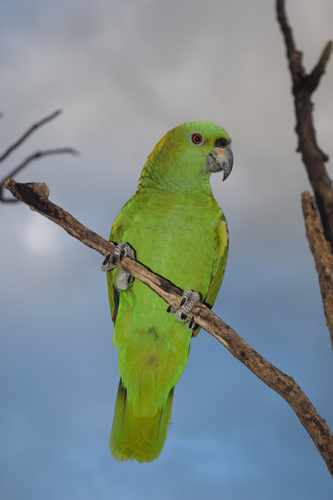
The yellow-naped amazon, Amazona auropalliata (Lesson, 1842), can be identified by its green forehead and crown, and a yellow band across the lower nape and hindneck. It has orange eyes, a dark gray beak that is paler near the base of the upper mandible, and dark gray feet. This parrot species lives in tropical dry forest and mangrove habitats, and nests in naturally occurring tree cavities. While yellow-naped amazons do not excavate their own cavities, they will chew to modify the cavity entrance. They may nest in a wide variety of trees, and dead Coyol palm trees are a preferred nesting option. During the breeding season, pairs are monogamous, and pairs defend small breeding territories around their nest by duetting with each other. Breeding success is only 11%, with 89% of nests failing, and the majority of nest failures are caused by poaching. The vocal behavior of yellow-naped amazons has been studied more extensively than that of any other wild parrot. Like all parrots, yellow-naped amazons demonstrate vocal learning behavior in the wild. This behavior appears as vocal dialects: the repertoire of calls these parrots use changes at distinct geographic boundaries, just as humans have different languages and dialects. These dialects are meaningful to the parrots, as they respond less strongly to calls from outside their own dialect. Dialects also remain stable over long periods of time. Mated yellow-naped amazon pairs duet together on their territories in highly complex patterns, producing precisely coordinated, synchronized sequences of calls. These duets follow syntactic rules, where the order and structure of notes changes in predetermined but flexible ways. Neighboring pairs of yellow-naped amazons perform counter-duets, in which pairs rapidly exchange duets. This behavior is similar to counter-singing seen in male songbirds. These displays occasionally become heated enough to lead to physical fights at territory boundaries, though such fights are rare. The species is found along the Pacific Coast from southern Mexico south to northern Costa Rica. Recent population surveys show declining populations across most of this range. Populations are already reduced in Costa Rica and Nicaragua, and have become extremely small in Honduras, Mexico, and Guatemala. The Mesoamerican Parrot Census Network, with support from the World Parrot Trust, engages volunteers to survey yellow-naped amazon populations across their range to support conservation efforts. Like many parrot species, the yellow-naped amazon feeds on nuts, berries, seeds, and fruit.