About Amazilia tzacatl (de la Llave, 1833)
The scientific name of the rufous-tailed hummingbird is Amazilia tzacatl (de la Llave, 1833).
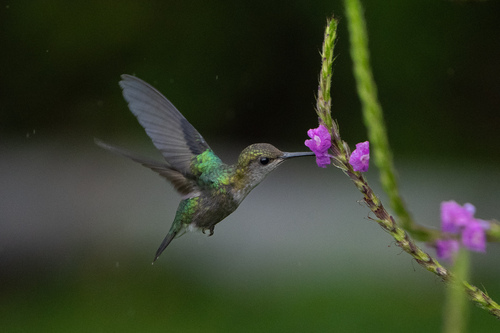
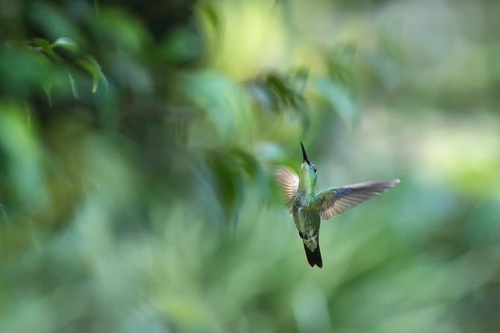
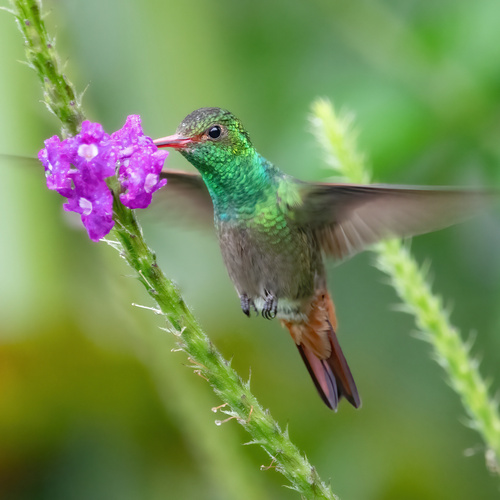
Description: The rufous-tailed hummingbird measures 9 to 11 cm (3.5 to 4.3 in) in length and weighs about 5 g (0.18 oz). For the adult male of the nominate subspecies, the head and upperparts are green, except the lores and uppertail coverts which are chestnut-brown. Most of its tail is also chestnut-brown, which gives the species its English common name; the outer webs and tips of the tail feathers are bronze green. Its throat, upper breast and flanks are green, and the throat feathers sometimes have thin white edges that create a scalloped effect. Its lower breast is gray, belly is white, and undertail coverts are chestnut-brown. The adult female has paler gray lower breast than the male, and the scalloped effect on its throat is more pronounced. Juveniles have a cinnamon tint on the lower breast and flanks, and the feathers of the lower back and rump have narrow cinnamon tips. For the bill, the outer half of the maxilla is black and the inner half is red; the mandible is red with a black tip.
Its song is described as "varied, high, thin, squeaky chirping, tsi, tsi-tsi-tsit tsi-tsitsi tsi-si-si." Its calls include "a fairly hard, smacking tchik-tchik...or...tchi tchi..., at times repeated insistently" and "dry, hard chips often run into a rattling chirr-rr-rr-rr-rr".
Different subspecies have distinct characteristics: A. t. handleyi shares the same color pattern as the nominate subspecies, but is significantly larger and darker. A. t. fuscicaudata is smaller than the nominate, with a shorter and stouter bill. For A. t. jucunda, the maxilla is pinkish brown instead of black, its belly is darker gray than the nominate's, and the bronze green area on its tail is narrower. A. t. brehmi is similar to A. t. jucunda and A. t. fuscicaudata, but has longer wings and tail. It has a longer bill than A. t. fuscicaudata, and has reduced green coloring on the tail just like A. t. jucunda.
Distribution and habitat: Different subspecies have different distribution ranges: A. t. tzacatl is distributed from the eastern Mexican states of Veracruz and Oaxaca, south through Belize, Guatemala, Honduras, Nicaragua, and Costa Rica, into most of Panama; it apparently does not occur in El Salvador. A. t. handleyi is found on Isla Escudo de Veraguas off the Caribbean coast of northwestern Panama. A. t. fuscicaudata lives in the Cauca River and Magdalena River valleys of northern and western Colombia, extending east into Lara and Táchira states of western Venezuela. A. t. brehmi is distributed along the upper Güiza River in Nariño Department, Colombia. A. t. jucunda ranges from Chocó Department in western Colombia, south through western Ecuador to Loja Province. The South American Classification Committee (SACC) of the American Ornithological Society extends the range of A. t. jucunda into Peru.
The rufous-tailed hummingbird lives in open, non-forested landscapes such as clearings, gardens, and forest edges. It also occurs in low, young, brushy secondary forests, and frequently visits feeders for food. In terms of elevation, it ranges from sea level to 1,200 m (3,900 ft) in Mexico, up to 1,850 m (6,100 ft) in Costa Rica, 1,800 m (5,900 ft) in Colombia, and 1,700 m (5,600 ft) in Venezuela. In Ecuador it can be found as high as 2,500 m (8,200 ft), though this elevation occurrence is thought to be local or seasonal.