About Amauropelta noveboracensis (L.) S.E.Fawc. & A.R.Sm.
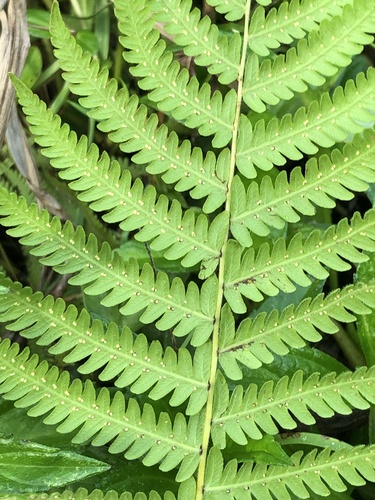
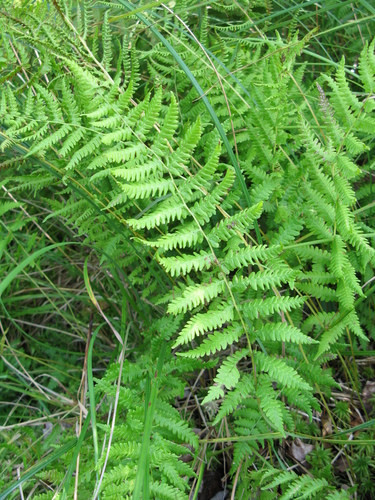
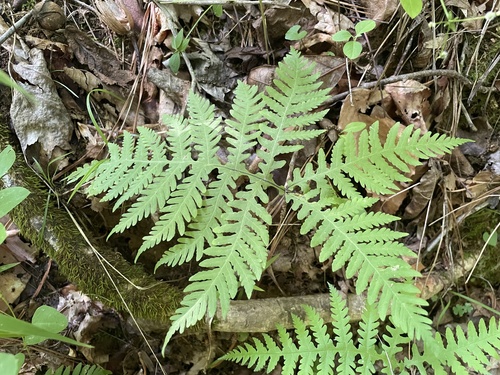
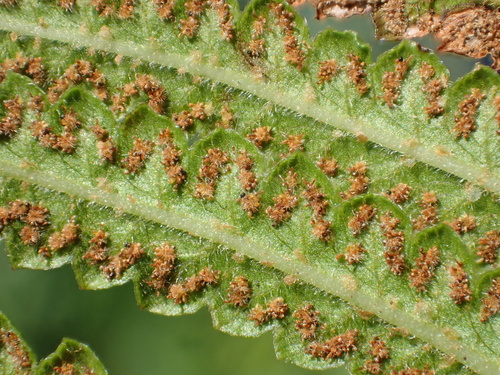
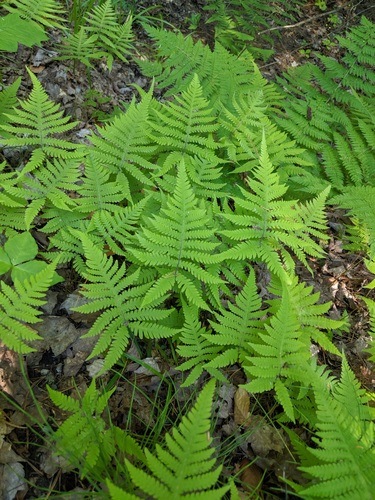
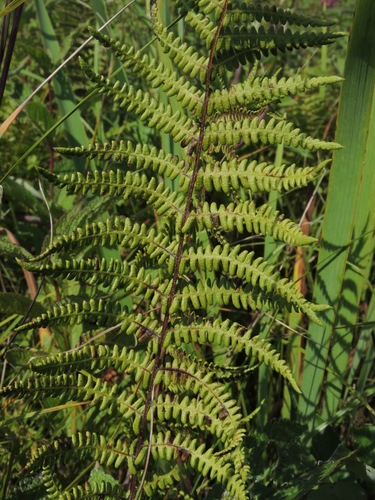
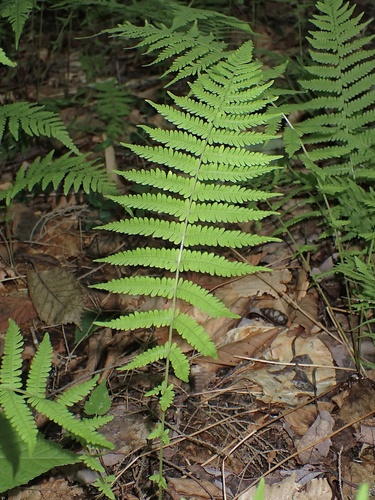
This fern grows in clumps of three or more fronds along a dark brown, slightly scaly rhizome. Each frond is supported by a stipe that makes up 20% of the total leaf length; the stipe is brown at the base, and turns green as it approaches the leaflets. The base of the stipe is typically covered in brown scales, while the upper section of the stipe is finely hairy. The entire leaf measures 8–25 inches (20–64 cm) long, is yellow-green, rather soft and thin in texture, and tapers at both ends. The lowest 4 to 10 leaflets are generally smaller than the leaflets located above them on the frond. The leaf is divided into approximately 20 pinnae (leaflets), and these leaflets are deeply cut into smaller, oblong, rounded subleaflets. This species produces both fertile and sterile fronds. Fertile fronds are larger and more upright, and bear small, round sori near the margins of the pinnae that do not touch the margins. These sori are covered by a tan, hairy, kidney-shaped indusium. This fern is distinct for its pinnae that taper toward the base of the frond, and for forming extensive clonal colonies on ridgetops and mountain benches. The only other native species in the local area with similarly tapering pinnae is ostrich fern, which generally grows in riparian habitats and grows much taller, reaching up to 1.5 m (4.9 ft). The only other species that forms similarly extensive clonal colonies is hay-scented fern. Unlike hay-scented fern, New York fern (Amauropelta noveboracensis) grows along dark brown, slightly scaly trailing rhizomes. For comparison, hay-scented fern grows along a smooth rhizome with only one frond arising at each node. Hay-scented fern also has leaflets with much more finely cut or jagged edges, while New York fern typically has smooth, rounded edges on its leaflets. New York fern is common in sunny patches created by canopy gaps in mixed woodlands, near vernal seeps, at the edge of swamps, in wooded ravines, and along streams. When soil pH drops below 4.1, this fern can become a dominant understory species. In these situations, it may out-compete the seedlings of certain tree species, some of which are commercially important. Seedlings of Prunus serotina are especially vulnerable, as the fern releases an allelopathic phenol that can kill them. This fern is a wetland indicator, and it is classified as an endangered species in Illinois.