About Amatitlania nigrofasciata (Günther, 1867)
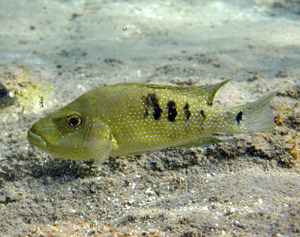
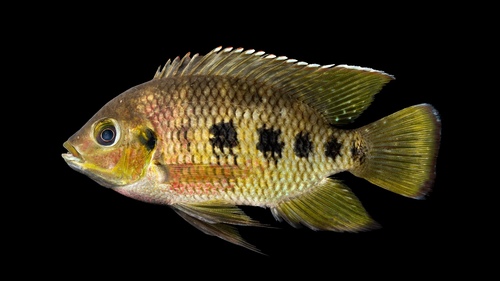
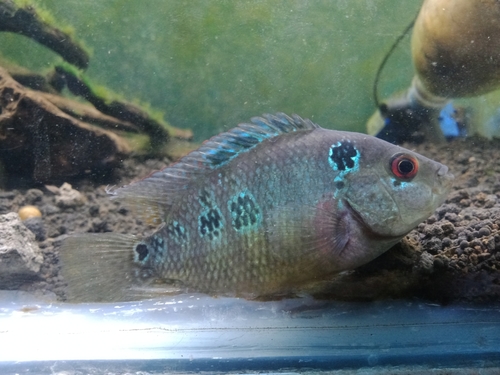
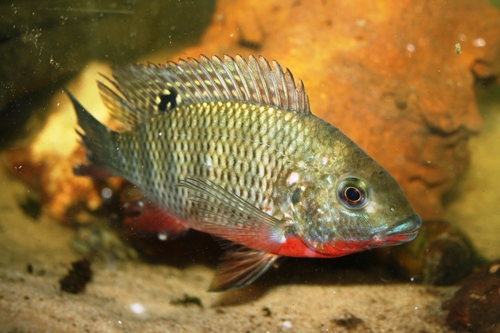
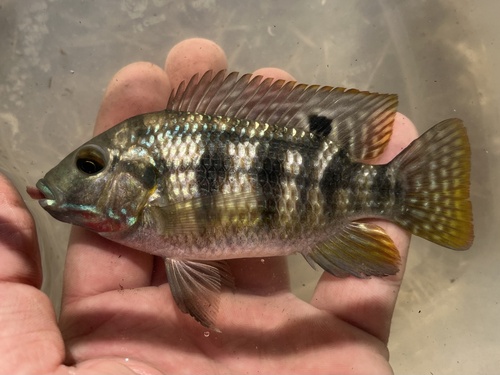
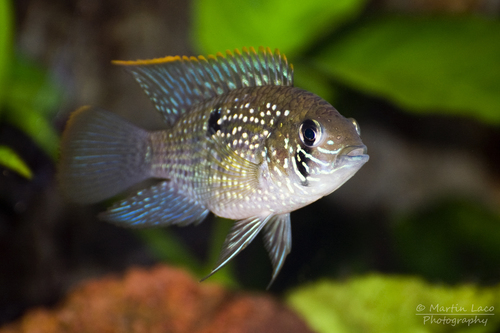
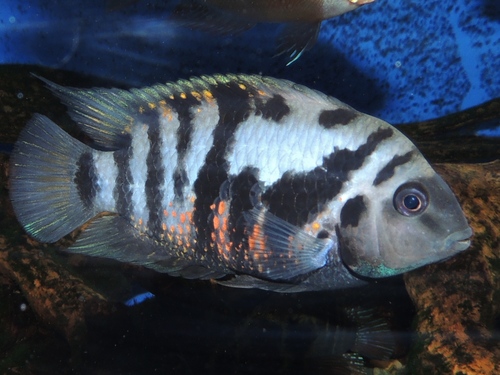
Amatitlania nigrofasciata, commonly called the convict cichlid, has the following description. Wild-type individuals of this species have 8 or 9 black vertical bars on a blue-grey body, plus a dark blotch on the operculum. Juvenile convict cichlids are monomorphic until they reach sexual maturity. Mature males are mostly gray with faint black body stripes, are larger than females, and have more pointed ventral, dorsal and anal fins that often extend into filaments. Older males also frequently develop small vestigial fatty lumps on their foreheads. Unusually for fish, female convict cichlids are more brightly colored than males. Females have more intense black body bands, with pink to orange coloration on their ventral region and dorsal fin. The maximum reported standard length of this species is 10 centimeters, with a total length close to 12 centimeters (4.7 in). Body weight is typically around 34–36 grams (1.2–1.3 oz). Selective breeding has produced a leucistic strain that lacks the dark barring seen in wild-type individuals. This strain is commonly known by multiple names: white convicts, pink convicts, gold convicts, and A. nigrofasciata "Kongo". The leucistic coloration comes from a mutation in an autosomal gene and is inherited as a recessive trait. Convict cichlids are native to lakes and streams across Central America. Specifically, they are found along Central America’s eastern coast from Guatemala to Costa Rica, and along the western coast from Honduras to Panama. This species prefers moving water, and is most often found in habitats that provide cover in the form of rocks or sunken branches. Measurements taken from four natural convict cichlid habitats in Costa Rica found pH ranged from 6.6–7.8, and carbonate hardness (KH) ranged from 63 to 77 ppm CaCO3. Daily water temperature in these habitats ranges from 26–29 °C (79–84 °F). Convict cichlids are relatively tolerant of cool water, which lets them colonize volcanic lakes at elevations up to 1,500 meters (4,900 ft). Convict cichlids can reach sexual maturity as early as 16 weeks old, though sexual maturity most commonly occurs at 6 months of age. Sexually mature convict cichlids form monogamous pairs that spawn in small caves or crevices. In the wild, these fish excavate their own caves by moving earth out from underneath large stones. Females adhere their eggs to the walls of the prepared cave. Like most cichlids, convict cichlids provide parental brood care for both eggs and free-swimming fry. Eggs hatch approximately 72 hours after fertilization. Until hatching occurs, the parents keep intruders and potential egg predators away from the nest. They also fan the eggs, moving water over the clutch with their fins to provide oxygen. Fanning occurs both day and night; at night, the fish use their sense of smell to detect the eggs in darkness, and keep their pelvic fins in contact with the eggs to maintain the correct distance for effective fanning. In darkness, the mated pair recognizes each other and detects predators using their sense of smell. After hatching, the larvae spend another 72 hours absorbing their yolk sacs and developing their fins before becoming free-swimming fry. The fry forage in dense schools during daylight, and return to the cave or crevice to spend the night. Like other cichlids, the parent fish retrieve their young just before dark, sucking up three or four fry at a time to carry them back to the nest. Parent convict cichlids anticipate the approach of night using an internal sense of time; laboratory experiments found they continued retrieving young as night approached even when no external signal such as dimming light was present. During the night, the fry cluster together at the bottom of the cave or nest, where the parents continue fanning them. Both parents stay involved in guarding the fry from brood predators, and perform behaviors that help the fry feed, such as moving leaves or fin digging to expose food by digging up substrate with their fins. Brood care for eggs, larvae and free-swimming juveniles in the wild lasts 4 to 6 weeks, and most wild females only breed once per season. In contrast, females kept in aquaria are known to breed multiple times per year, with short 12 or 13 day intervals between successive broods, as long as suitable surfaces such as rocks are available for egg-laying.