About Amathia verticillata (delle Chiaje, 1822)
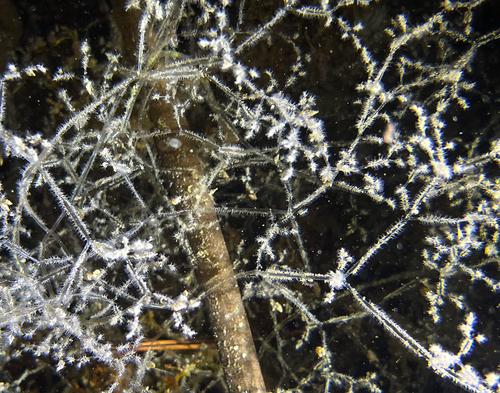
Amathia verticillata forms colonies that resemble miniature trees, reaching up to one metre across. Each colony is made up of a dense cluster of feeding individuals called autozooids, connected to one another by slender, branching stolons with a diameter of 0.5 mm. Stolons anchor to a substrate via an adhesive disc, are translucent, and can be brownish or bluish in colour. Autozooids arrange in two rows along each stolon; each is sac-shaped, and measures between 0.4 and 0.6 mm in length. At the mouth of each autozooid is a retractable, crown-like feeding structure called a lophophore, which bears eight short tentacles. The stolon has a jointed appearance, and is made of a series of tubular, non-feeding heterozooids. All zooids in a colony connect to each other through pores in their walls, allowing coelomic fluid to move along the stolon and between adjacent autozooids. Colonies of Amathia verticillata occur in shallow tropical and subtropical waters of the western Atlantic, the Caribbean Sea, and many other regions worldwide. It can tolerate a range of water conditions, but grows best when water salinity is at least 30ppt and water temperature is above 22 °C (72 °F). It is a common species in Florida's Indian River Lagoon, where it grows vigorously between April and September, and dies back over the winter. Amathia verticillata is a fouling organism. Its typical habitat includes growing on seagrass blades, large seaweed thalli, mangrove roots, rocky reefs, bivalve mollusc shells, man-made structures such as piers and breakwaters, boat hulls, floating seaweed mats, and other floating debris. Amathia verticillata sometimes grows alongside the honeysuckle tunicate Perophora viridis, and the two species' stolons intertwine. Amathia verticillata colonies provide shelter for juvenile fish, plus the amphipods, copepods, polychaete worms, and other small invertebrates that these juvenile fish prey on. The tissues of Amathia verticillata contain secondary metabolites that make the species unpalatable to many would-be predators. The main secondary metabolite is a bromo-alkaloid, which prevents mussel and barnacle larvae from settling on the bryozoan's colony. One of the only organisms that feeds on Amathia verticillata is the nudibranch Okenia zoobotryon, which is thought to live, feed, and lay eggs almost exclusively on this bryozoan. The tissues of this nudibranch may also contain the same anti-predator chemicals found in Amathia verticillata.

