About Amata phegea Linnaeus, 1758
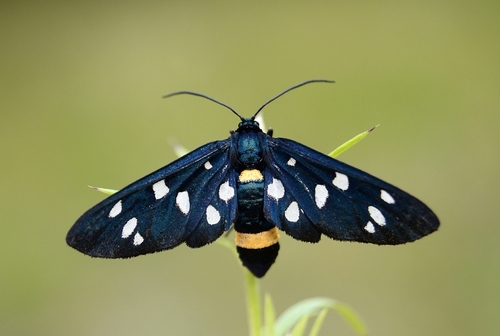
Amata phegea (the nine-spotted moth) has a wingspan of 35–40 millimetres (1.4–1.6 in). Males are smaller than females and have thicker antennae. Its wings are blueish black or greenish black with white spots and a metallic sheen; the number and size of these spots are quite variable. Usually, there are six white spots on the forewings and two or three spots on the hindwings. The body is quite long, with a yellow spot on the second segment of the abdomen. A distinct additional feature is the prominent yellow ring on the sixth segment of the abdomen. Its black thread-like antennae have white tips. Fully grown caterpillars reach a length of about 5 centimetres (2.0 in). They are gray black, covered in thick dark brown fluffy hairs that grow from small tubercles, and have a reddish brown head. Similar-looking species include Amata ragazzii (Turati, 1917) and Zygaena ephialtes (Linnaeus, 1758). Z. ephialtes belongs to the family Zygaenidae and is unpalatable to birds. The nine-spotted moth mimics the appearance of Z. ephialtes through Müllerian mimicry, and both species are examples of aposematism. The nine-spotted moth is chiefly found in southern Europe, and has also been recorded as far north as northern Germany, and east as far as Anatolia and the Caucasus. Small populations exist in the south-eastern Dutch nature reserves of Leudal and Meinweg. It does not breed in the United Kingdom, where it is only a very rare immigrant. It has also been found in India in recent times. This species prefers drier habitats, including open areas with shrubs and trees, open forests, and warm sunny slopes.