About Amaryllis belladonna L.
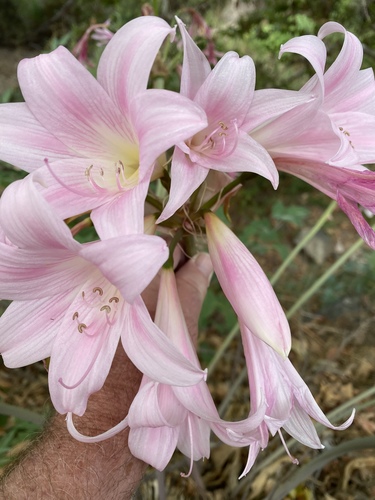
Amaryllis belladonna L. is a perennial bulbous geophyte that produces one to two erect solid stems in late summer. Its inflorescence holds 2–12 showy, fragrant, funnel-shaped flowers on a "naked", leafless stem, which gives the species its common name naked-lady-lily. The pink flowers can grow up to 10 cm long, and appear in autumn before leaves emerge, a trait called hysteranthy; the leaves themselves are narrow and strap-shaped. This species is native to South Africa, where wild plants grow among rocks. Leaves of A. belladonna start growing in early spring or late autumn, persist from a few weeks to a few months before withering, after which a flower stalk begins to grow. In the wild, A. belladonna is pollinated by hawk moths and carpenter bees. Its flower has a long-tubed, pale perianth that fully opens at night, then releases a sweet fragrance containing the acyclic terpenoid alcohol linalool, along with abundant nectar, that attracts pollinators. The seeds of A. belladonna are soft and fleshy, white or pinkish in color, and dispersed by wind during winter, to coincide with the first winter rains in March and April. Seeds can germinate in as little as two weeks, but do not develop into fully flowering plants until three to six years after germination. All parts of A. belladonna are toxic, containing several alkaloids including lycorine, pancracine and amaryllidine. In humans, consumption of this plant can cause vomiting and diarrhea. In wildlife, the toxins affect grazing species, causing drooling, vomiting, diarrhea, abdominal distress, lethargy, and heart or renal failure. Deer tend to avoid eating this plant, possibly due to an evolutionary relationship. For cultivation, bulbs are best planted just below the soil surface, with the neck of the bulb level with the soil surface. In colder climates, bulbs require mulching, or lifting and overwintering. Bulbs can be propagated from offsets. Amaryllis bulbs need little watering and are drought tolerant. This plant has earned the Royal Horticultural Society's Award of Garden Merit. Several compounds have been found in the bulbs of A. belladonna, including the alkaloid 1,4-dihydroxy-3-methoxy powellan. Observations have found that alkaloids from this plant's bulbs have activity against malaria caused by Plasmodium falciparum.