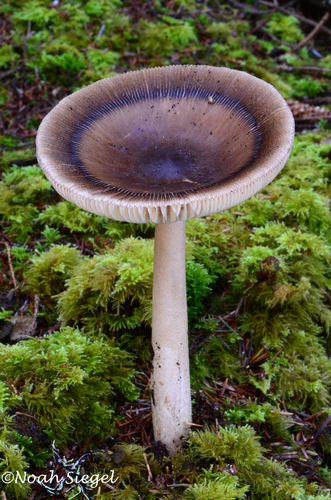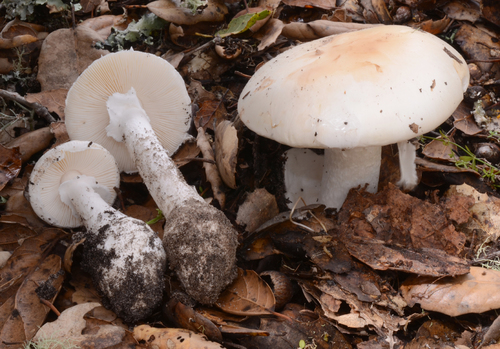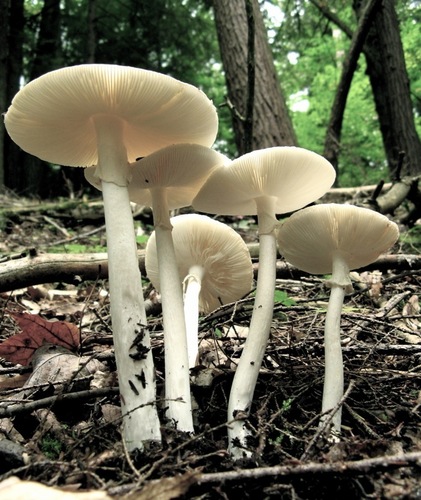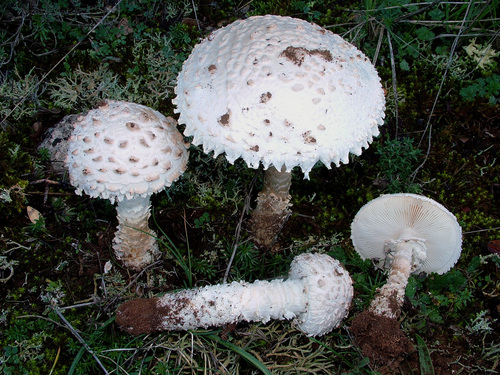
About Amanita virosa Bertill.
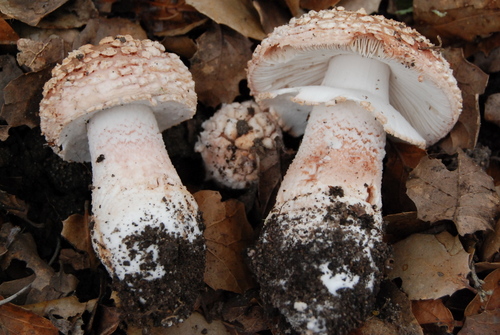
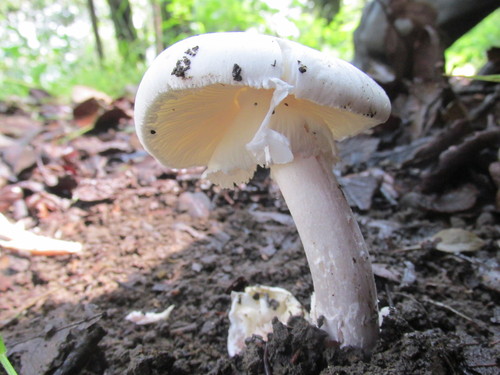
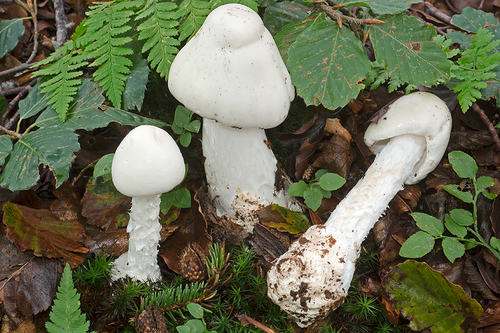
When Amanita virosa first develops, it starts as a white, egg-shaped structure covered by a universal veil. As the fungus grows, its mushroom-shaped fruit body breaks out of the veil, though ragged pieces of veil may remain along the edges of the cap. The cap starts out conical with inward-curving edges, then becomes hemispherical before flattening out, reaching a maximum diameter of 12 cm (4+3⁄4 in). The cap often has a distinctive raised central boss, its surface can be peeled, and it is overall white, though the centre may take on an ivory tone. The gills are crowded, free from the stipe, and white, just like the stipe and volva. The thin stipe grows up to 15 cm (5.9 in) tall, and bears a hanging, grooved ring. The spore print of this species is white; individual spores are subglobose, 7–10 μm long, and amyloid, meaning they stain purple when tested with Melzer's reagent. The flesh is white, smells similar to radishes, and turns bright yellow when exposed to sodium hydroxide. Amanita virosa grows in woodlands during late summer and autumn, and is especially commonly found growing in association with beech and chestnut trees, though it also associates with pine, spruce, and fir. Like most species in the Amanita genus, it forms an ectomycorrhizal mutualistic relationship with the roots of these trees. The species was first formally described from Sweden, and is confirmed to occur across Europe and northern Asia (specifically China). The name Amanita virosa was historically applied to similar-looking agarics in North America, but research has confirmed that these North American populations are separate distinct species: the eastern Amanita bisporigera, the western A. ocreata, and the northern Amanita amerivirosa. Amanita virosa is highly toxic, and has been the cause of many severe mushroom poisoning cases. A single cap of this fungus contains enough toxin to kill an adult human. Poisoning symptoms typically do not appear until several hours after consumption, and this delay can make effective treatment much more difficult. Fruit bodies contain both amatoxins and phallotoxins. Amatoxins are a group of at least eight structurally similar compounds, all built from eight amino-acid rings. These compounds were first isolated in 1941 by Heinrich O. Wieland and Rudolf Hallermayer of LMU Munich. α-Amanitin is the main amatoxin component, and along with β-Amanitin is likely responsible for the majority of the toxic effects. The primary mechanism of toxicity is inhibition of RNA polymerase II, an enzyme required for synthesis of messenger RNA (mRNA), microRNA, and small nuclear RNA (snRNA). Without mRNA, essential protein production stops, halting cell metabolism and leading to cell death. The liver is the organ most affected, since it is the first organ the toxins reach after absorption from the gastrointestinal tract, but other organs (especially the kidneys) are also vulnerable to damage. Phallotoxins are a group of at least seven compounds, all with seven similar peptide rings. Phalloidin, the main phallotoxin, was isolated in 1937 by Feodor Lynen, Heinrich Wieland’s student and son-in-law, and Ulrich Wieland of LMU Munich. While phallotoxins are highly toxic to liver cells in laboratory settings, they contribute little to overall poisoning in humans because they are not absorbed through the intestinal tract. Additionally, phalloidin is also found in the edible blusher mushroom Amanita rubescens. A third group of minor active peptides, virotoxins, consist of six similar monocyclic heptapeptides. Like phallotoxins, they do not produce acute toxicity when ingested by humans. It is not currently known why A. virosa, which looks very similar to common edible mushroom species, is linked to fewer fatal poisonings than the death cap, though its relative rarity may be a contributing factor. Some mushroom experts strongly warn against placing A. virosa fruit bodies in the same collecting basket as edible mushrooms, and advise people to avoid unnecessary handling of the fungus. This species is only toxic when ingested, however. In laboratory studies, extracts of Amanita virosa have shown antibacterial activity against Pseudomonas aeruginosa and Staphylococcus aureus. Extracts have also demonstrated inhibitory activity against thrombin.