About Amanita sinicoflava Tulloss
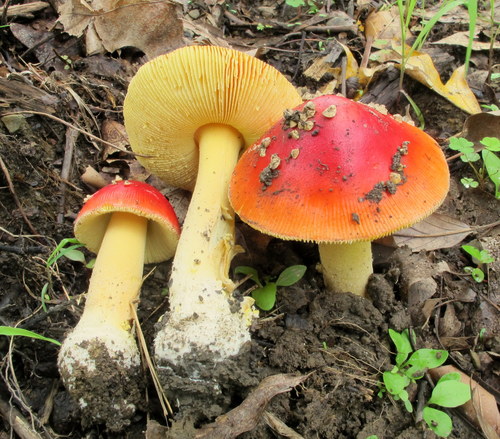
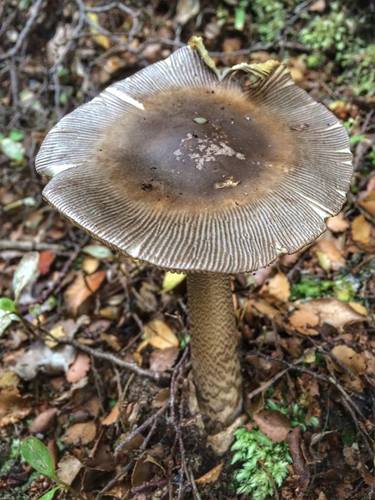
Amanita sinicoflava, commonly known as the mandarin yellow ringless amanita, is an edible species of mushroom belonging to the large genus Amanita. Its fruitbodies produce yellow-olivaceous or olive-tan caps that measure 2.5 to 7 centimetres (1 to 3 inches) in diameter. Grooves are present on the cap margin, extending roughly 40% of the distance from the margin toward the cap apex. The spores of Amanita sinicoflava are spherical or nearly spherical, with typical dimensions ranging from 9.1 to 12.2 micrometres (0.36 to 0.48 mils) by 8.4 to 11.5 μm (0.33 to 0.45 mils). Its stipe is white and decorated with slightly darker fibrils, and sac-like remnants of the volva are located at the base of the stipe. The specific epithet sinicoflava translates to "Chinese-yellow", a name chosen to reference the color of the species' cap. This fungus is found in North America, and was formally described as a species new to science in 1998 by mycologist Rodham Tulloss. The type collections used to establish the species were collected in Sussex County, New Jersey. It grows in sandy soil beneath trees of the species Quercus, Pinus rigida, Acer rubrum, Quercus alba, and Quercus velutina.