About Amanita rubrovolvata S.Imai
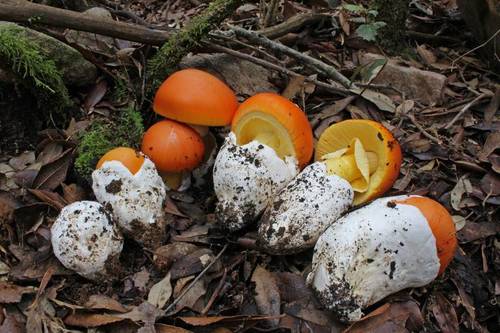
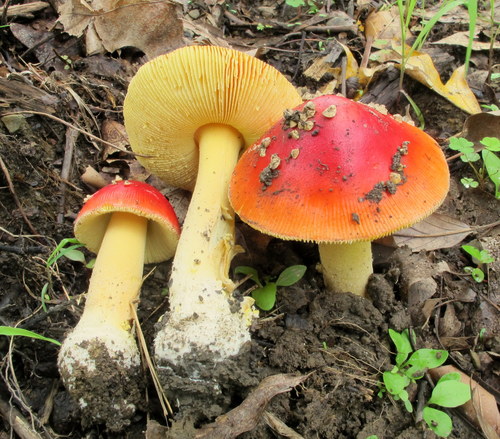
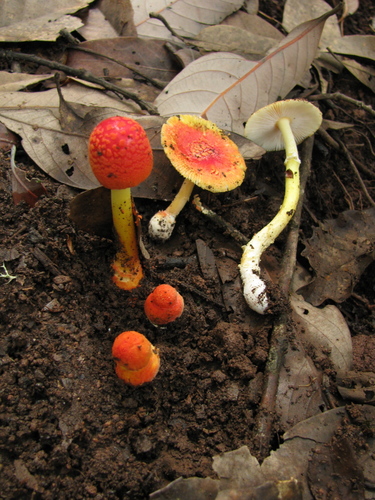
The cap of Amanita rubrovolvata is 2.0–6.5 centimetres (13⁄16–2+9⁄16 inches) wide, ranging in shape from convex to flattened, and sometimes has a slight umbo. Cap color is dark red to reddish-orange, fading to paler orange to yellowish at the margin. The cap surface is densely covered with red to orange to yellow, powdery to granular volva remnants. The cap margin has grooves that extend 30% to 60% of the cap radius, and no partial veil remnants hang along the cap margin. The mushroom's flesh is white to yellow, or reddish immediately beneath the cap cuticle. The gills are white, free from attachment to the stem, and 3 to 6 mm (1⁄8 to 1⁄4 in) broad. Lamellulae — short gills that do not reach fully from the cap edge to the stem — are truncate, and typically range in length from 15% to 50% of the full length of the gills. The stem measures 50–100 mm (2–4 in) long by 5–10 mm (1⁄4–3⁄8 in) thick. It is roughly cylindrical or slightly wider toward the top, with a cream-colored surface above the ring, and cream to yellowish below the ring. The bulb at the base of the stem is roughly spherical, 1–2 cm (1⁄2–3⁄4 in) wide, and its upper part is covered with red, orange to yellow woolly to powdery volva remnants. In mature specimens, the volva remains as a ring around the upper part of the stem bulb. The ring is membranous and persistent, with a white upper surface, a yellowish-tinged lower surface, and a red to orange edge. A. rubrovolvata produces a white to cream-colored spore print. Spores are spherical or nearly spherical, and typically measure 7.5–9.0 by 7.0–8.5 μm. They are inamyloid, meaning they do not absorb iodine stain from Melzer's reagent. Basidia — the spore-bearing cells in the hymenium — are club-shaped, four-spored (rarely two-spored), and measure 25–44 by 10–14 μm. Sterigmata, the slender extensions at the tips of basidia that attach to spores, are 3–4 μm long, and clamp connections are not present at the bases of basidia. A. rubrovolvata mushrooms grow in groups on the ground. Like other Amanita species, this fungus forms mycorrhizal relationships with trees: this mutually beneficial relationship sees fungal hyphae grow around tree roots, allowing the fungus to receive moisture, protection, and nutritive byproducts from the tree, while giving the tree greater access to soil nutrients. Original Japanese collections of the species came from forests dominated by Japanese beech (Fagus crenata). It has also been found growing near Quercus luecotrichophora, Rhododendron arboreum, and Myrica esculenta in India, in Castanopsis-Schima forest in Nepal, and in Castanopsis indica plantations in the Himalayas. A. rubrovolvata occurs in China, northern India, Nepal, Gharwal Himalaya, South Korea, and Southeast Asian countries such as Thailand; its southern distribution limit extends to the southern Malay Peninsula. While the edibility or toxicity of this mushroom is not known with certainty, studies in mice found that peritoneal injection of fruit body extract caused neurological symptoms, increased blood glucose levels, and decreased blood urea nitrogen. Reported additional biochemical changes in tested mice include reduced acetylcholinesterase enzyme activity and reduced liver glycogen levels. In these experiments, measured values returned to normal six hours after initial injection. This suggests the poisoning was not serious, and did not impact liver or kidney function.