About Amanita ochrophylla (Cooke & Massee) Cleland
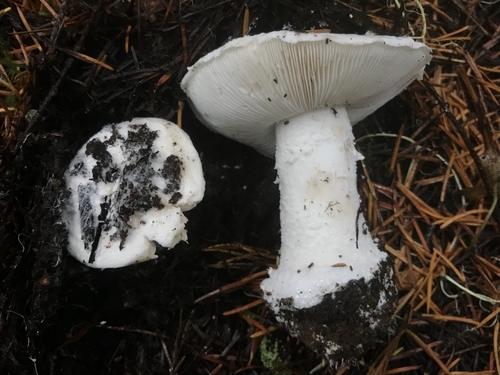
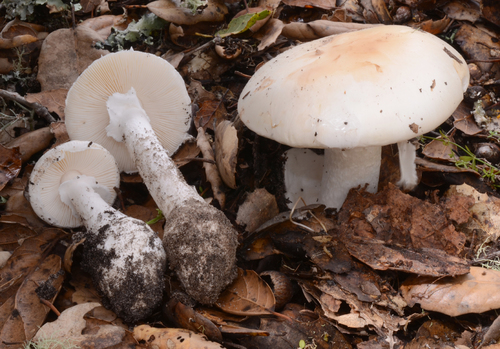
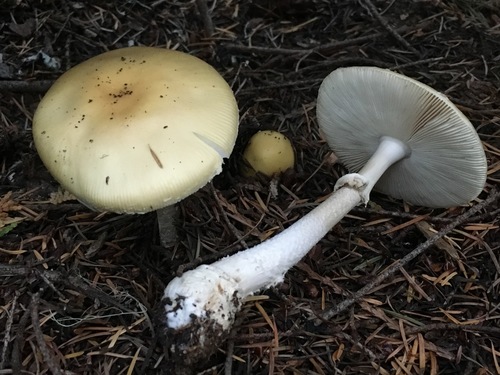
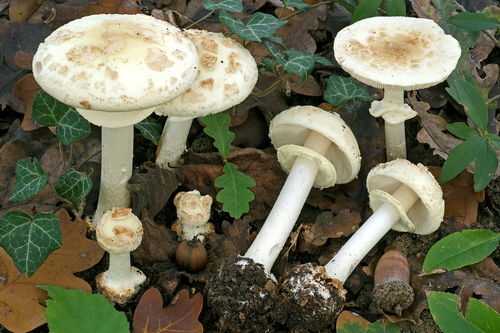
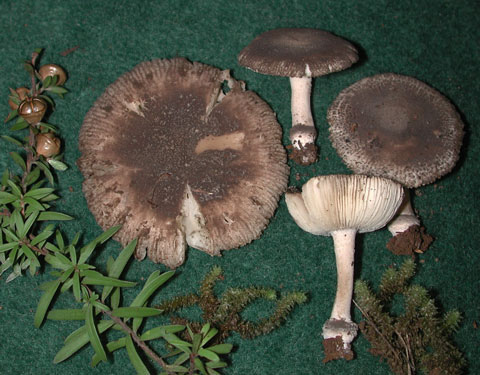
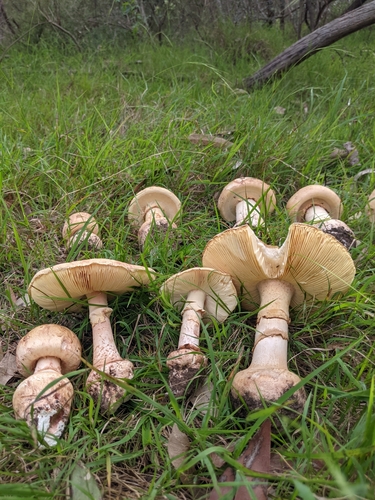
Amanita ochrophylla produces large, stocky fruit bodies that are buff or ochre in overall color; sometimes the stalk or cap shows additional orange or pink tones. When young, the cap is convex and rounded, and it opens and flattens as it matures, becoming flat-convex or completely flat. The cap can reach up to 30 centimeters (12 inches) in diameter, and is often covered with small, thin, flat scales that are slightly paler than the main cap color. The gills are thin, crowded, free from attachment to the stalk, and cream or buff in color, and darken as the mushroom ages. This species produces a white spore print. The thick stalk has a characteristic double ring that aids identification. The main upper ring attaches high on the stalk, just below the gills; it is membranous and may break off. The second lower ring is smaller and thicker. The solid stalk grows up to 15 cm (6 in) tall and 2 cm (3⁄4 in) wide. It has a large, bulbous base shaped like an inverted cone that can reach up to 4 cm in diameter. Under microscopic examination, spores are oval-shaped and measure 9.3–10.8 by 5.4–7.4 μm. The mushrooms have a stale odor that smells similar to ants. Amanita ochrophylla is distributed across southeastern Australia, and has been recorded in southeastern South Australia, Victoria, throughout New South Wales, and Queensland. In Tasmania, forestry records note it occurs predominantly in wet forests, including at Mount Wellington. Fruit bodies emerge after heavy rainfall, and often grow along roadsides. A field study found that fruit bodies of A. ochrophylla with identical genetic profiles covered areas up to 60 m (200 ft) in diameter, suggesting this comes from a single genetic individual, meaning such single individuals can reach up to 60 m (200 ft) across in undisturbed eucalypt forest. The unpleasant stale odor usually discourages people from attempting to eat this species, and its edibility remains unknown. Near Wedderburn, south of Sydney, a Lao family harvested and consumed this species, possibly alongside Amanita volvarielloides. One family member developed poisoning with hepatotoxic effects matching those of deadly amanitas, and A. volvarielloides is suspected to be the cause of this poisoning.