About Amanita novinupta Tulloss & J.Lindgr.
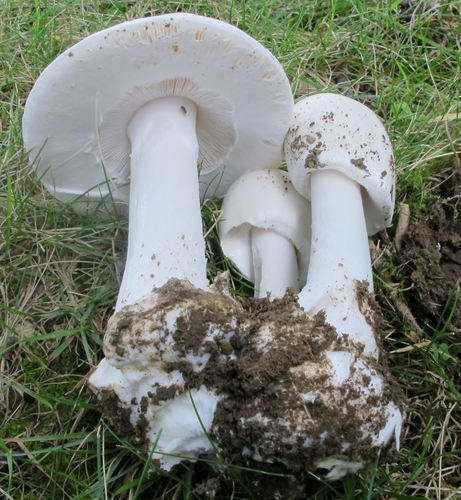
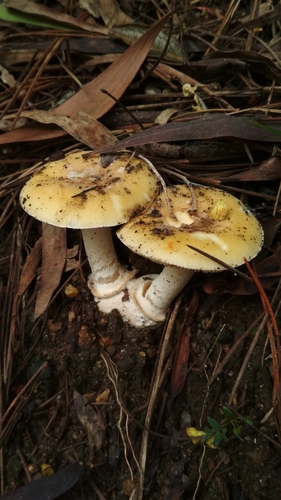
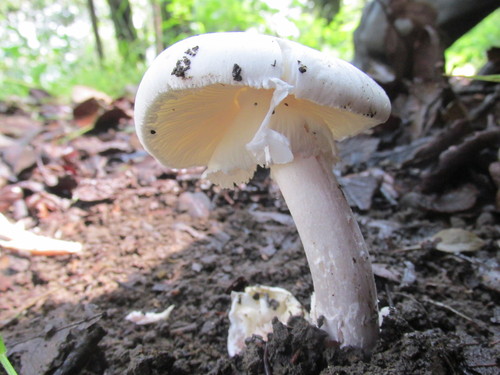
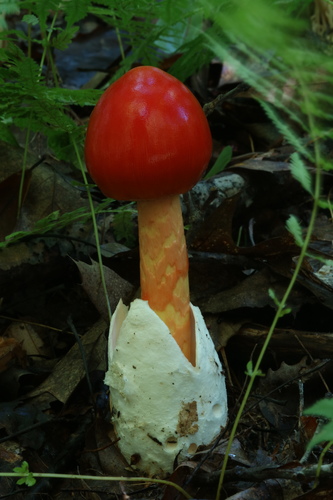
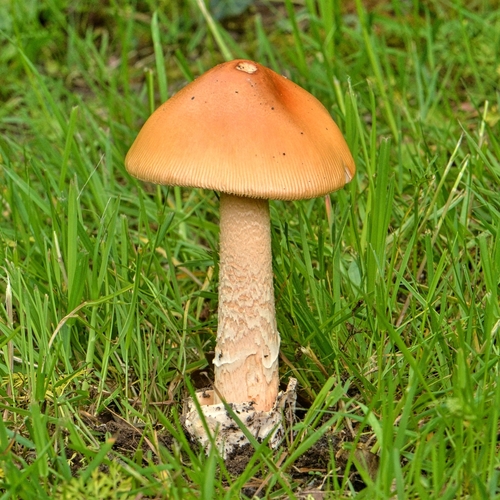
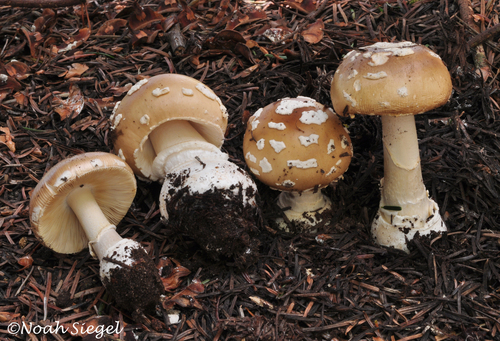
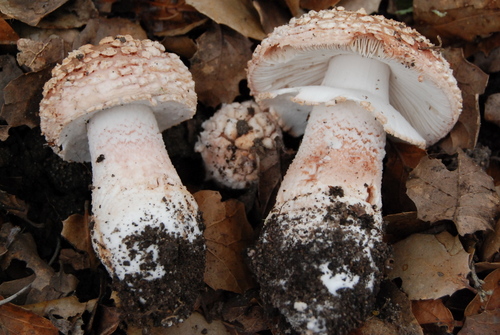
This entry covers Amanita novinupta Tulloss & J.Lindgr. and related species in the Amanita rubescens group. For Amanita rubescens, the cap is reddish-brown and convex, measuring 5–15 centimetres (2–6 inches) across, scattered with small white-to-mahogany warts. It is sometimes covered with an ochre-yellow coating that can be washed away by rain. The mushroom's flesh is white, and turns pink when bruised or exposed to air. The stem (stipe) is white with tints matching the cap colour, and grows to 5–15 cm tall. The gills are white, free from the stem, and develop red spots when damaged. The upper surface of the ring has distinct ridges (striate). Spores are white, ovate, amyloid, and measure approximately 8 by 5 μm. Uncooked flesh has a mild flavour with a faint acrid aftertaste, and the odour is not strong. Amanita novinupta has a whitish cap 5–15 cm wide, a stem up to 12 cm long, flesh that blushes pink when damaged, a mild smell, and a white spore print. In terms of distribution and habitat, Amanita rubescens is common across much of Europe and Asia. It grows on poor soils as well as in deciduous and coniferous woodlands, and appears from June through November in the United Kingdom. It has also been recorded in South Africa, where it is thought to have been accidentally introduced alongside European imported trees. Amanita novinupta is found in western North America, particularly in California. Additionally, several other North American species are classified as A. amerirubescens. In terms of ecology, in eastern North America, species in the A. rubescens group are frequently parasitized by the fungus Hypomyces hyalinus. Parasitized fruiting bodies are very hard to recognize unless they grow alongside healthy ones, though some retain the group's characteristic "blushing" trait. For uses, A. rubescens is edible when cooked. Raw A. rubescens contains a toxic hemolytic protein, but the toxin is destroyed by cooking and does not appear to cause harm when cooked. Some mushroom reference works list it as poisonous: David Pegler notes that eating large quantities of raw A. rubescens can cause severe anaemia if left untreated, and classifies it as a mushroom that causes blood cell damage from haemolytic poisoning. A. rubescens also resembles some toxic mushroom species.