About Amanita muscaria (L.) Lam.
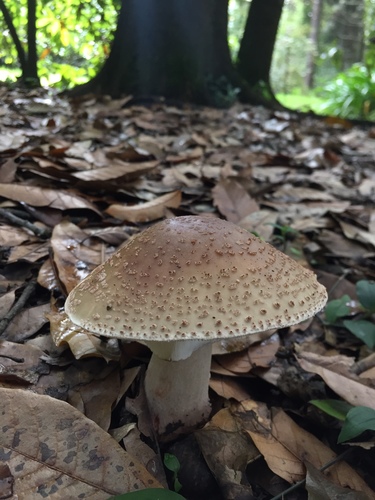
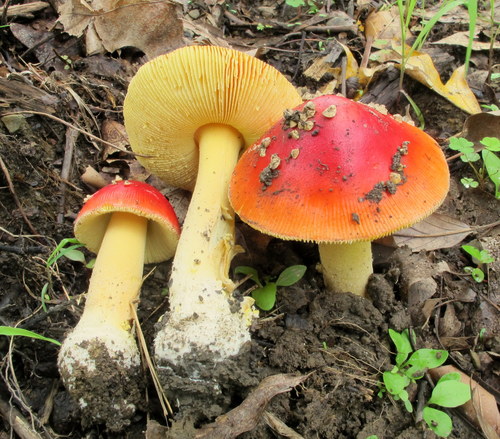
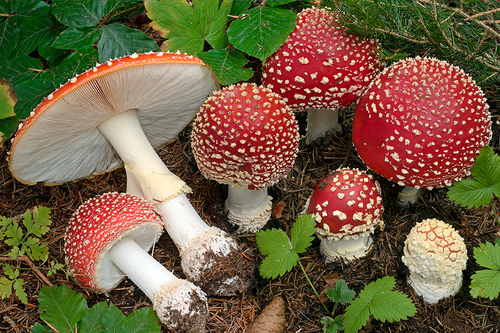
Amanita muscaria (L.) Lam. is a large, conspicuous mushroom that is generally common and numerous where it grows, often found in groups with basidiocarps at all stages of development. Fly agaric fruiting bodies emerge from the soil looking like white eggs. After emerging from the ground, the cap has irregularly distributed small white to yellow pyramid-shaped warts. These warts are remnants of the universal veil, a membrane that encloses the entire mushroom when it is still very young. Dissecting the mushroom at this stage reveals a characteristic yellowish layer of skin under the veil, which helps with identification. As the fungus grows, red colour appears through the broken veil and the warts become less prominent; they do not change in size, but are reduced in prominence relative to the expanding cap skin area. The cap changes shape from globose to hemispherical, and finally becomes plate-like in mature specimens. The bright red cap ranges from 5–30 centimetres (2–12 inches) in diameter. Age and rain may cause the red colour to fade and the warts to fall off. The free gills are white, as is the spore print. The oval spores measure 9–13 by 6.5–9 μm; they do not turn blue when iodine is applied. The stipe is white, 5–20 cm (2–8 in) high by 1–2 cm (1⁄2–1 in) wide, and has the slightly brittle, fibrous texture typical of many large mushrooms. At the base of the stipe is a bulb that bears remnants of the universal veil in the form of two to four distinct rings or ruffs. Between the basal universal veil remnants and gills are remnants of the partial veil (which covers the gills during development) in the form of a white ring. This ring can become quite wide and flaccid with age. There is generally no distinct associated smell other than mild earthiness. A. muscaria is a cosmopolitan mushroom, native to conifer and deciduous woodlands throughout the temperate and boreal regions of the Northern Hemisphere, including higher elevations of warmer latitudes in regions such as the Hindu Kush, the Mediterranean and Central America. In North America, it is native to parts of Alaska, and occurs alongside imported European trees near the West Coast. A recent molecular study proposes that it had an ancestral origin in the Siberian–Beringian region in the Tertiary period, before radiating outwards across Asia, Europe and North America. The fruiting season varies in different climates: fruiting occurs in summer and autumn across most of North America, but occurs later in autumn and early winter on the Pacific coast. This species is often found in locations similar to those where Boletus edulis grows, and may appear in fairy rings. Carried with pine seedlings, it has been widely transported into the Southern Hemisphere, including Australia, New Zealand, South Africa and South America, where it can be found in the Brazilian states of Paraná, São Paulo, Minas Gerais and Rio Grande do Sul. A. muscaria is ectomycorrhizal, and forms symbiotic relationships with many trees, including pine, oak, spruce, fir, birch, and cedar. It is commonly seen under introduced trees, and acts as the fungal equivalent of a weed in New Zealand, Tasmania and Victoria, forming new associations with southern beech (Nothofagus). The species is also invading a rainforest in Australia, where it may be displacing native species. It appears to be spreading northwards in Australia, with recent reports placing it near Port Macquarie on the New South Wales north coast. It was recorded growing under silver birch (Betula pendula) in Manjimup, Western Australia in 2010. Although it has apparently not spread to associate with eucalypts in Australia, it has been recorded growing in association with eucalypts in Portugal. It is commonly found throughout the large southern region of western Australia, and is regularly found growing on Pinus radiata. A. muscaria poisoning has occurred in young children, people who ingested the mushrooms for a hallucinogenic experience, or people who confused it with an edible species. A. muscaria contains several biologically active agents, at least one of which, muscimol, is known to be psychoactive. Ibotenic acid, a neurotoxin, serves as a prodrug to muscimol, with a small amount likely converting to muscimol after ingestion. An active dose in adults is approximately 6 mg muscimol or 30 to 60 mg ibotenic acid; this is typically about the amount found in one cap of A. muscaria. The amount and ratio of chemical compounds per mushroom varies widely from region to region and season to season, which further complicates predicting effects. Spring and summer mushrooms have been reported to contain up to 10 times more ibotenic acid and muscimol than autumn fruitings. Unlike some other mushrooms in the Amanita genus, A. muscaria does not contain the highly toxic cyclic peptide α-Amanitin. Deaths from A. muscaria have been reported in historical journal articles and newspaper reports, but with modern medical treatment, fatal poisoning from ingesting this mushroom is extremely rare. Many books list A. muscaria as deadly, but according to David Arora, this is an error that implies the mushroom is far more toxic than it actually is. Furthermore, the North American Mycological Association has stated that there were no reliably documented cases of death from toxins in these mushrooms in the past 100 years. The active constituents of A. muscaria are water-soluble; boiling and then discarding the cooking water at least partly detoxifies it. Drying may increase potency, as the process facilitates the conversion of ibotenic acid to the more potent muscimol. According to some sources, once detoxified, the mushroom becomes edible. Patrick Harding describes the Sami custom of processing fly agaric through reindeer.