About Amanita jacksonii Pomerl.
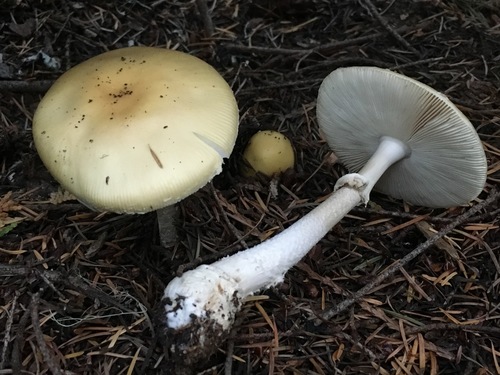
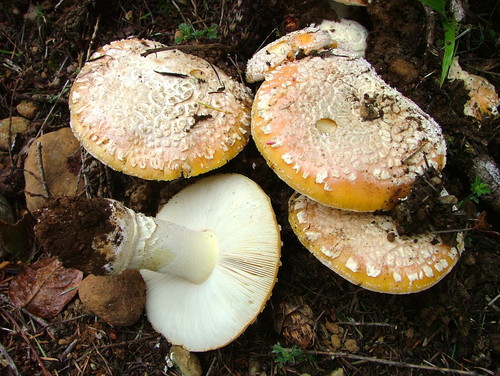
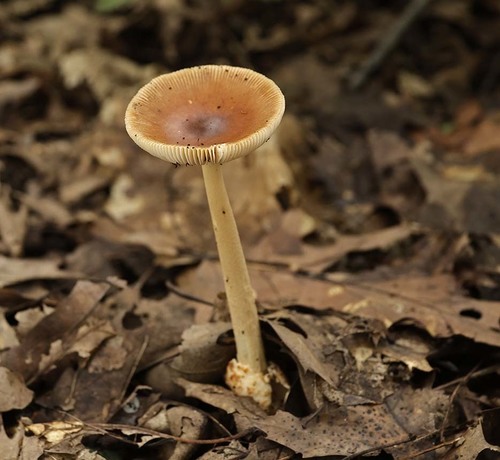
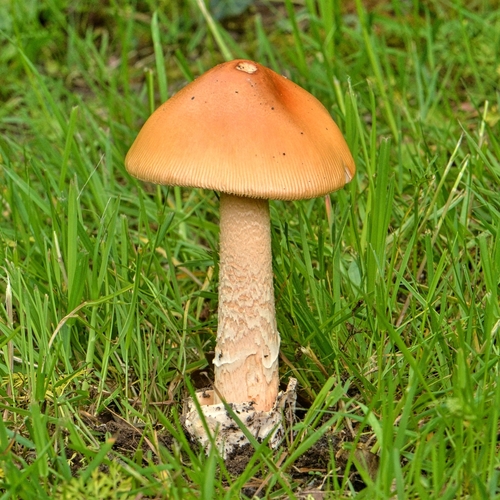
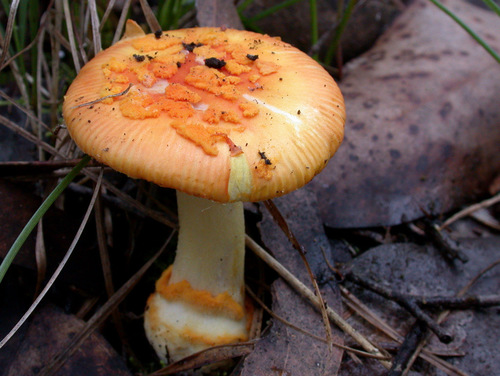
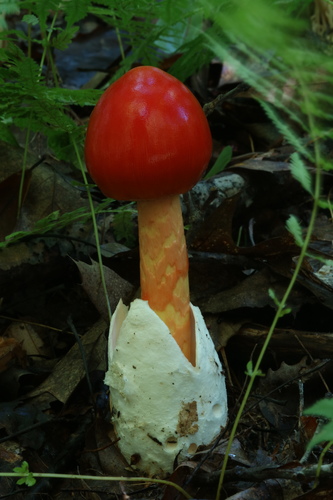
Amanita jacksonii Pomerl. is an edible mushroom species. Its cap is 8–12 cm (3–4+1⁄2 inches) wide, oval when young that becomes convex, and typically has a central bump. The cap surface is sticky, colored a brilliant red or orange, fading to yellow at the margin, and usually lacks warts or patches. The cap margin is lined along roughly 40–50% of the cap radius, and the red pigment fades from the margin inward toward the center as the mushroom ages. The gills are moderately crowded to crowded, range in color from orange-yellow to yellow-orange to yellow, are either free from the stipe or slightly attached to it, and do not bruise when damaged. Short gills are subtruncate to truncate. The stipe measures 90–140 by 9–16 millimeters (3+1⁄2 in–5+1⁄2 in × 1⁄4 in–3⁄4 in), is yellow, and decorated with orange fibrils and patches that are leftover from a felted extension of the limbus internus of the otherwise white volva. Spores measure (7.0-) 7.8–9.8 (-12.1) × (5.2-) 5.8–7.5 (-8.7) μm, are broadly ellipsoid to ellipsoid (rarely subglobose or elongate), and are inamyloid. Clamp connections are common at the base of basidia. The flesh is whitish to pale yellow, and does not change color when exposed to air. The species’ range stretches from Quebec, Canada, south to at least Hidalgo State, Mexico, and it has also been observed as far south as Cayo District, Belize. It is considered a choice edible mushroom, but it can be mistaken for toxic species including Amanita muscaria and Amanita phalloides.