About Amanita crocea (Quél.) Singer
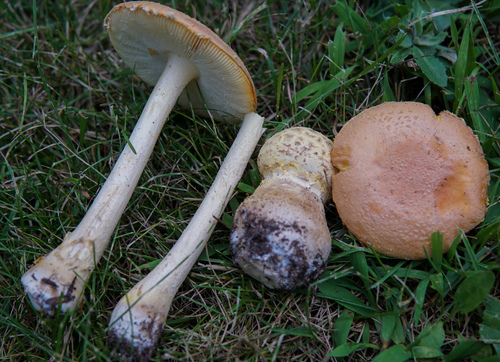
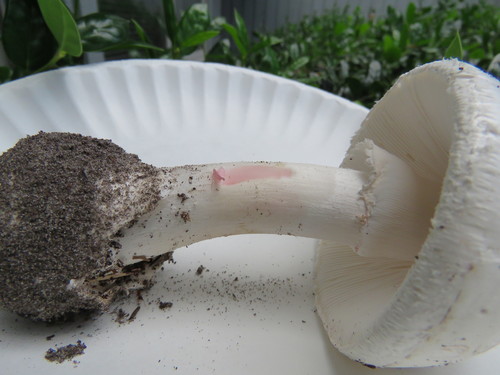
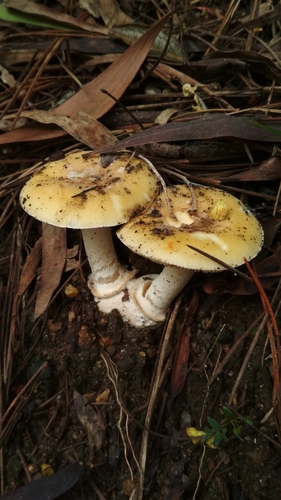
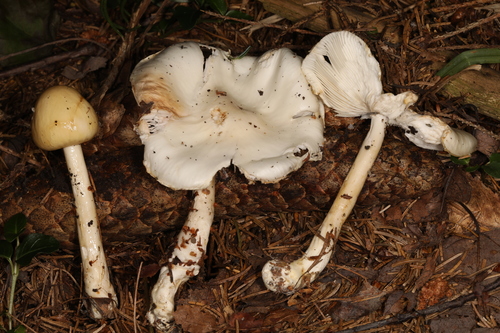
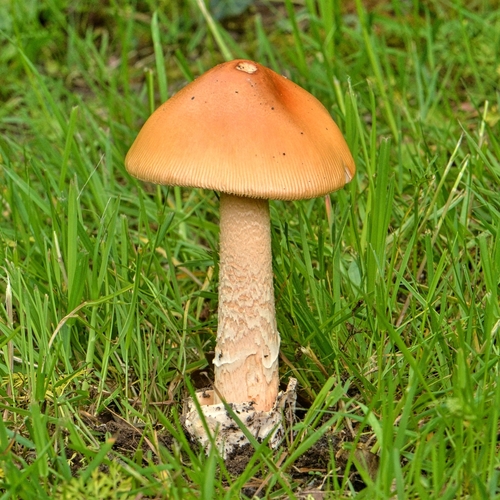
The cap of Amanita crocea has no remaining partial veil rings, has a diameter of 5–10 centimetres (2–4 inches), and is yellow-orange, with an apricot tint at its centre. It expands to become flat, or sometimes remains convex at the umbo – a small raised central area. The volva is thick and white, measuring at least 4–10 cm (1+1⁄2–4 in) wide; when fresh, the centre is saffron orange or slightly browner than saffron orange, and the margin is paler. The gills are unattached to the stem, and are cream-coloured overall, sometimes showing a slight salmon or pinkish tint, and measure 2–3± millimetres broad. The stem, also called stipe, is 10–15 cm (4–6 in) long and 1–1.5 cm in diameter, tapering, marked with paler fibrils arranged in a "flame" pattern. These markings later become orange or brown-orange, darker than the underlying surface of the stipe, and a membranous sack-like volva is present at the base of the stipe. The spores are white, and measure (8.0-) 9.4–11.8 (-18.8) by (7.5-) 8.5–11.0 (-16.0) μm. This fungus grows infrequently between July and October, forming mycorrhizal associations with hardwood trees, most commonly birch and beech growing in clearings. It has a sweet odour and a mildly nutty, sweet taste. It has also been reported to occur in Iran. Although Amanita crocea is edible, foraging guides advise against eating it, since many similar-looking Amanita species are highly poisonous.