About Amanita australis G.Stev.
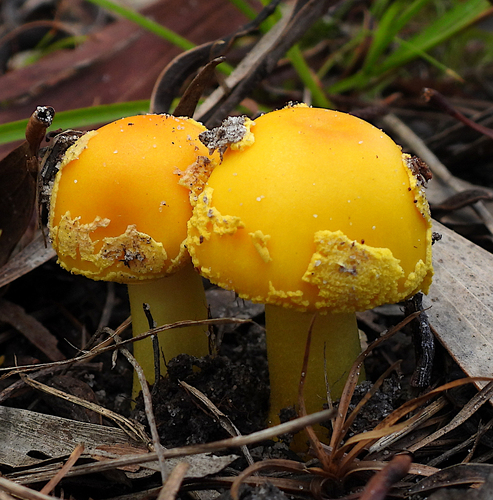
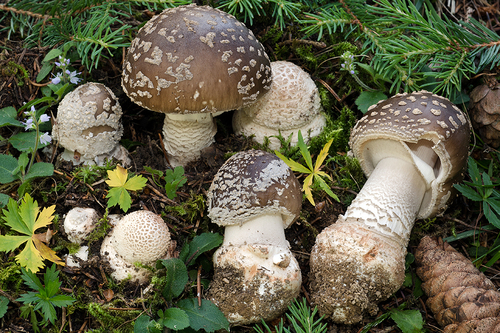
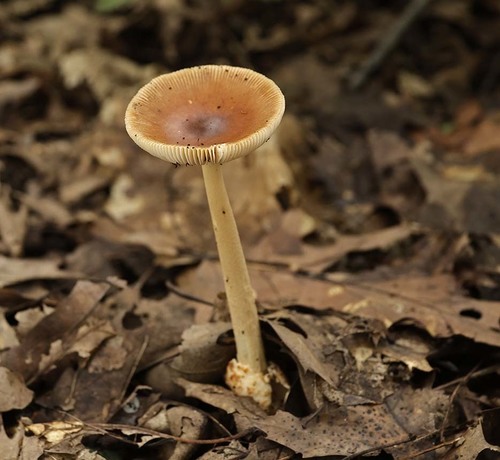
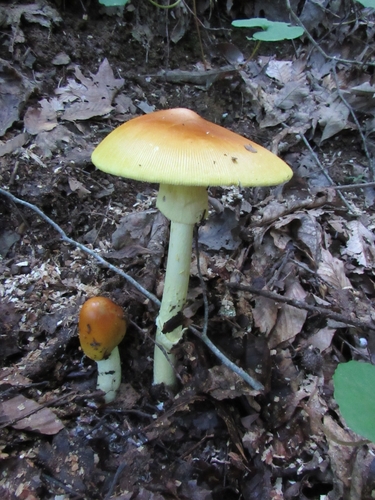
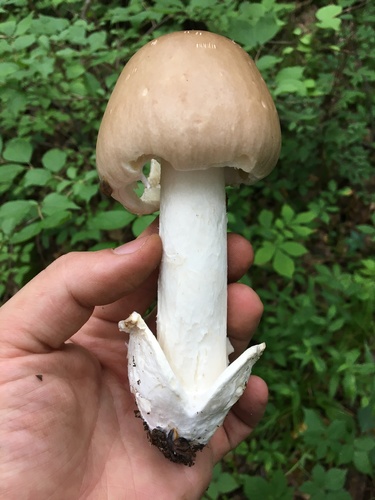
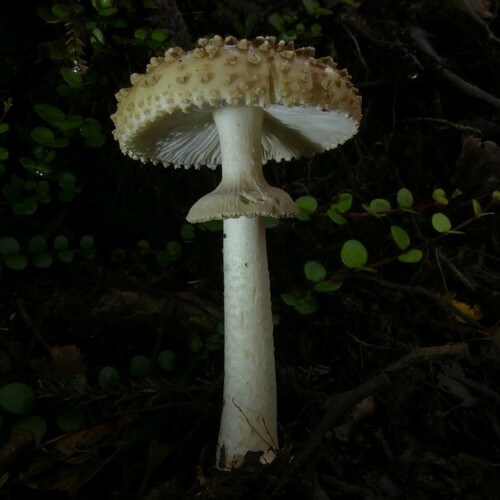
Amanita australis G.Stev. has a cap that starts convex before flattening out, sometimes developing a central depression, and reaches 2–9 centimetres (3⁄4–3+1⁄2 inches) in diameter. The cap margin sometimes splits and rolls back, creating a ragged look. The cap centre is dark buff, honey, or isabelline, and fades to paler buff at the margin. When young or wet, the cap surface is sticky, and it dries out as it ages. Volva remnants form conical to pyramidal warts that are densest at the cap centre, becoming sparser and lower towards the margin. These warts start white, then turn greyish-sepia or isabelline with white to buff tips. The gills are closely crowded, not attached to the stem, 6–10 mm (1⁄4–3⁄8 in) wide, and white. Short gills that do not reach fully from the cap edge to the stem (called lamellulae) have truncated ends. The stem is 37–90 mm (1+1⁄2–3+1⁄2 in) tall, 6–26 mm (1⁄4–1 in) in diameter, narrowest at its centre, hollow, and has an abruptly bulbous base 14 to 38 mm (1⁄2 to 1+1⁄2 in) in diameter. The stem surface above the ring is white and covered in woolly mycelia tufts; below the ring, it is white with buff to greyish transverse grooved bands. The base may or may not have a rim of powdery volval remnants, coloured greyish-buff to greyish-sepia. The ring is membranous, white to buff, hangs freely when young and later adheres to the stem. The cap flesh is white, occasionally pale isabelline under the cap centre; the stem flesh is also white. The spore print is white. Spores are typically 9–12 by 8–10.5 μm, spherical to ellipsoid, thin-walled, hyaline (translucent), and amyloid—they stain bluish-black to black in Melzer's reagent. Basidia measure 43.5–76.5 by 10.5–17 μm, are mostly four-spored, and have clamps at their bases. Abundant spherical, elliptic, or club-shaped hyaline cells are present on gill edges, measuring 16–39.5 by 10.5–27.5 μm. The cap cuticle is 220–270 μm wide, made up of a gelatinised upper layer (suprapellis) and a non-gelatinised lower layer (subpellis). Volval remnants on the cap contain abundant spherical, club-shaped, or turnip-shaped cells 10–86 by 9–85 μm. These cells are umber-coloured, arranged in chains perpendicular to the cap surface, becoming smaller and paler at the tip of the wart. They are subtended by moderately abundant hyphae 4–10 μm wide, and clamp connections are abundant in the hyphae. Amanita australis is only found on the North and South Islands of New Zealand. It grows in mycorrhizal association with southern beech of the genus Nothofagus, including New Zealand red beech, silver beech, New Zealand black beech, and hard beech, as well as with mānuka and kānuka. The fungus usually grows solitarily, and only rarely occurs in groups.