About Amanita aestivalis Singer
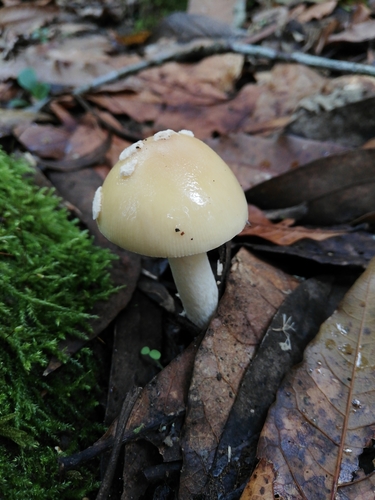
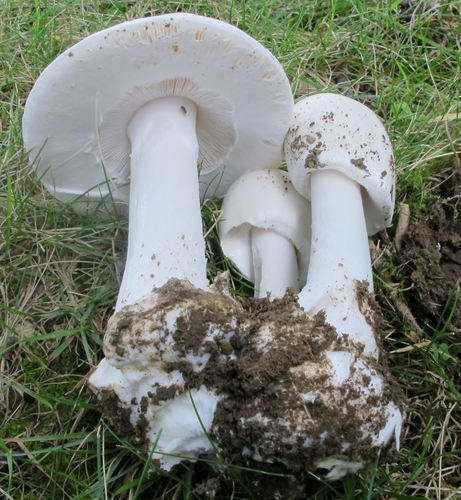
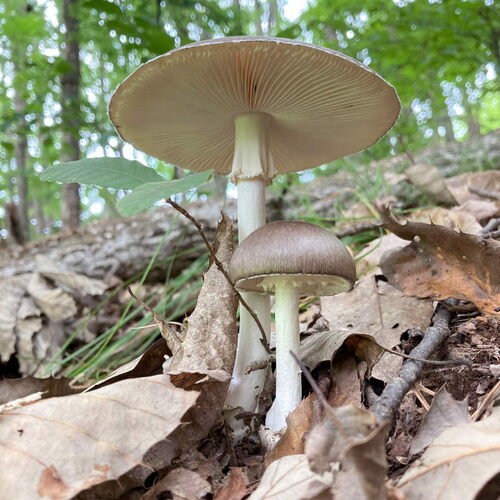
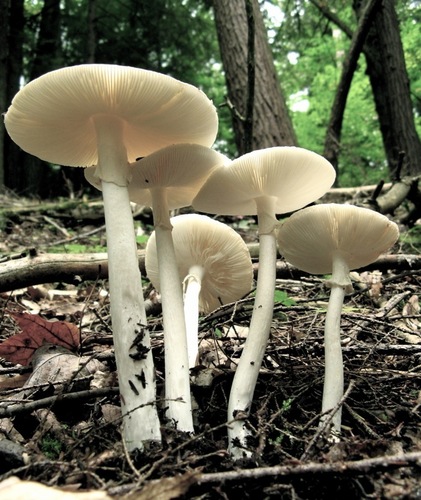
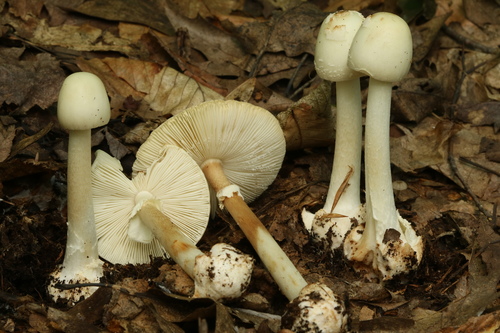
The fruit body of Amanita aestivalis Singer has a cap 5 to 8.5 centimetres (2 to 3+1⁄2 inches) in diameter. Depending on age, the cap ranges from egg-shaped to convex to somewhat flattened; older specimens may have upward-curved edges. The cap is white or pale tan at its center, and older specimens may develop brownish-red discolored patches. Sometimes the cap edge has radial grooves up to 4 millimetres (1⁄8 in) long that align with the positions of the underlying gills. The cap is sticky when moist and shiny when dry, and usually has no remaining remnants of the thin volva. The gills are white, crowded closely together, and free (not attached to the stem). They are subventricose, meaning they are slightly swollen in the middle and taper toward their ends. The stem is 8.5 to 16 cm (3+3⁄8 to 6+1⁄4 in) long and 0.9 to 1.6 cm (3⁄8 to 5⁄8 in) thick, and is slightly thicker at the base than at the top. It is filled with cotton-like whitish hyphae. The stem surface is either smooth or covered in delicate tufts of soft, white, woolly hairs. A rimmed bulb at the stem base can reach over 3 cm (1+1⁄8 in) in diameter. A white, membranous, long-lasting ring sits on the upper stem, 1.2–1.7 cm (1⁄2–5⁄8 in) below the stem top. The volva stays closely attached to the bulb, though a portion may stretch as a thin membrane to adhere to the stem base before collapsing. Injured or bruised flesh slowly turns pinkish-brown to chocolate-brown. Young specimens have no distinct odor, while older fruit bodies may have a faint smell of onion or garlic. For microscopic characteristics, spore prints of A. aestivalis basidiospores are white. Under a microscope, the spores are roughly spherical, hyaline (translucent), thin-walled, and measure 7.8–8.8 μm. The spores are amyloid: they absorb iodine when stained with Melzer's reagent and turn blue to blackish-blue. The spore-bearing basidia are four-spored, thin-walled, and measure 32–60 μm long by 4–13 μm thick. No clamp connections are present at the bases of the basidia. For distribution and habitat, fruit bodies typically grow from late June through autumn. In North America, this species has been found in New England states, plus Alabama, New York, and Virginia. Its range extends north to Canada's southeastern provinces and south to Florida. Fruit bodies grow on the ground in deciduous, coniferous, and mixed forests. It has a noted preference for oak woods that contain Tsuga or Pinus species, and for beech woods with Picea, Abies, and Betula. Amanita aestivalis is a mycorrhizal species, which means it forms a mutualistic relationship: the fungus's vegetative hyphae grow around and enclose the tiny roots of trees and shrubs. This arrangement helps the plant better absorb phosphorus and other soil nutrients, while the fungus receives moisture, protection, and nutrient byproducts from the plant's metabolism.