About Amandava subflava (Vieillot, 1819)
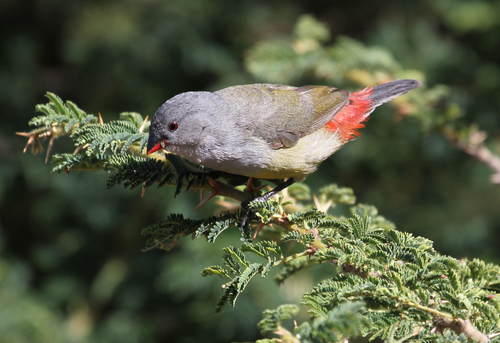
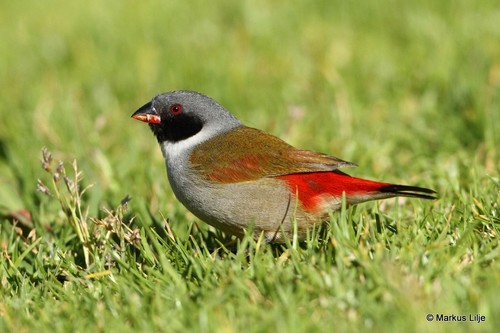
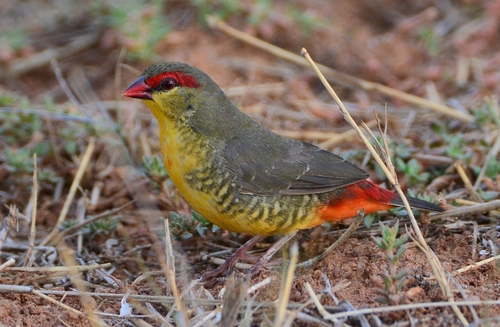
The orange-breasted waxbill, scientifically named Amandava subflava, is also commonly called the zebra waxbill. This is a small sparrow-like bird that measures approximately 9 cm in length. It has a reddish iris, orange breast, red bill, and dark olive-green plumage. Male individuals have a red rump, dark bars on their whitish flanks, and a scarlet eyebrow stripe that males are distinguished by. Females are duller in coloration and smaller in size than males, and they do not have the red eyebrow stripe that males possess. The orange-breasted waxbill occurs naturally in grasslands and savannas in Africa, across regions located south of the Sahara Desert. It has an estimated global extent of occurrence measuring 10,000,000 square kilometers. This species has also been introduced to other countries outside its native range, an example of which is Kuwait. The diet of the orange-breasted waxbill is made up primarily of seeds, insects, and young plant shoots. Females typically lay between four and six eggs per clutch, laid in an oval-shaped nest constructed from grass. These nests are often repurposed old nests that originally belonged to red-collared widowbirds. Because the species is widespread and common across its large range, the orange-breasted waxbill is classified as Least Concern on the IUCN Red List of Threatened Species. It is also listed on Appendix III of CITES for Ghana.