About Amandava amandava (Linnaeus, 1758)
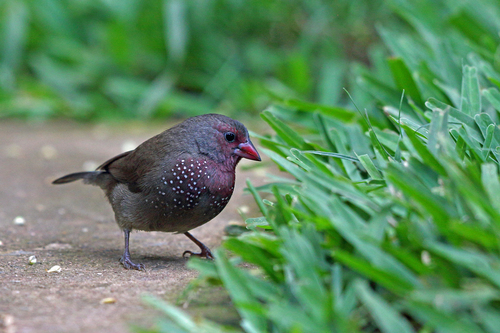
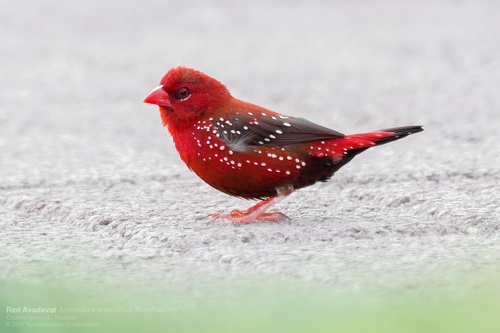
This small finch can be easily recognized by its rounded black tail and a bill that changes color seasonally to red. It has a red rump. Breeding males are red across most of their upper body, except for a black eye-stripe, lower belly, and wings; white spots appear on the red body and wing feathers. Non-breeding males are duller in color but retain the red rump, while females are also duller and have far less white spotting on their feathers. Red avadavats (Amandava amandava) live mainly on flat plains, in areas with tall grasses or crops, and are often found near water. The species has four named subspecies. The nominate subspecies, A. a. amandava, occurs in Bangladesh, India, Nepal, and Pakistan. The Burmese form, A. a. flavidiventris, is also found in parts of China, Indonesia, Thailand, and Vietnam. The population in eastern Java is classified as A. a. punicea, and the population in Cambodia is A. a. decouxi. Introduced populations are established in multiple locations around the world: southern Spain, Brunei, Fiji, Egypt, Malaysia, the United States, Bahrain, Guadeloupe, Iran, Italy, Réunion, Mexico, the Dominican Republic, Martinique, Portugal, Japan, Puerto Rico, Singapore, and Hawaii. This finch is typically seen in small flocks. It flies with rapid wingbeats, then drops into clumps of grass where it becomes difficult to spot. Pairs remain together through the breeding season. These birds make a distinctive low, single-note pseep call that is most often given in flight; their song consists of a series of low notes. Members of a flock will preen one another, ruffling their head feathers to invite preening. They feed primarily on grass seeds, but will also eat insects such as termites when available. They build a globular nest from grass blades, and the typical clutch holds around five or six white eggs. The beak begins turning red in May, darkens through November and December, changes rapidly to black in April, and repeats this cycle annually. This seasonal color change is tied to seasonal changes in daylength. Two species of ectoparasitic bird lice have been found on this species: the ischnoceran louse Brueelia amandavae, and the amblyceran louse Myrsidea amandava. A paramyxovirus has also been isolated from red avadavats kept in Japan.