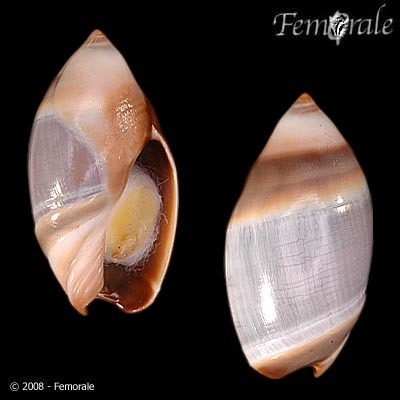
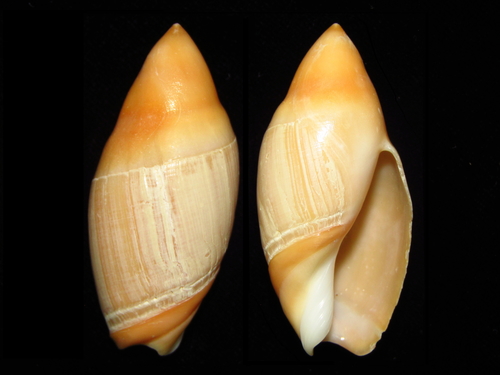
About Amalda marginata (Lamarck, 1811)
Amalda marginata (Lamarck, 1811) is a marine species with a shell that reaches a maximum length of 40 mm and diameter of 19 mm. Multiple historical descriptions of this species cover different forms. The original French description characterizes it as an oval, rounded shell with a pointed, transversely keeled spire. It is whitish with a smooth back, and its whorls have an interrupted reddish band decorating the area near their suture. The outer lip of its aperture has a small protruding denticle at the bottom. A description of this species under the synonym Baryspira (Alocospira) dyspetes notes the shell is medium-sized, with an open aperture and a slightly swollen shape. The spire is very short and tapered. The shell is primarily white, with a yellow band just behind the suture and a similarly colored anterior canal. The apex is made of two rounded whorls, which are followed by five nearly smooth adult whorls that only show a faint central spiral ridge. The base of the shell has around six shallow grooves. The inner lip is covered by a thin glaze that extends past the aperture onto the previous whorl. A description of this taxon as Ancillaria marginata var. tasmanica describes the shell as ovate-fusiform, solid, with a pyramidal spire that is shorter than the aperture. It has two spiral keels and is entirely white. The whorls are rounded and bordered above by a white callous band. On the front of the body whorl, features appear in the following order: first two equidistant spiral grooves, then a thick, broad, rounded varix, followed by a broad, flattened band, and finally 4-5 spiral folds. The inner lip is somewhat sharp and thin. The outer lip is callous at the back. The aperture is wide, with a broad notch at the base. This marine species is endemic to Australia, and occurs off the coasts of New South Wales, South Australia, Tasmania, Victoria and Western Australia.