About Alyxia buxifolia R.Br.
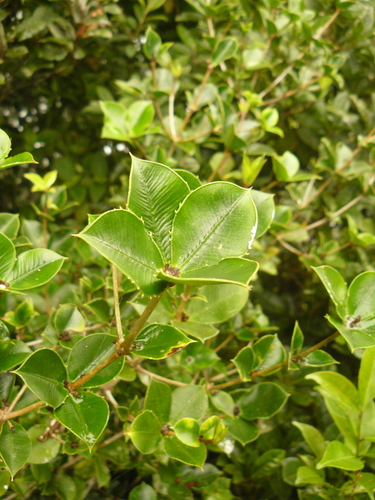
Alyxia buxifolia R.Br. is a dense, woody shrub that can reach up to 3 metres in both height and width. In its natural coastal habitats, harsh winds often mean specimens grow to less than 50 cm tall. This is a slow-growing plant with a spreading habit. The upper surface of its leaves ranges from medium to dark green, while leaf undersides are pale green. The leaves are thick, with a smooth, leathery texture. They are most often arranged in opposite pairs along the stem, but can also grow in groups of three. Leaves are elliptical to obovate in shape, between 1 cm and 5.2 cm long, and 0.5 cm to 2.5 cm wide. The leaf base is cuneate, narrowing toward the stem, while the leaf apex is apiculate, ending in a short point. Leaves sit very close to the stem, with petioles only 0.1 cm to 0.5 cm long.
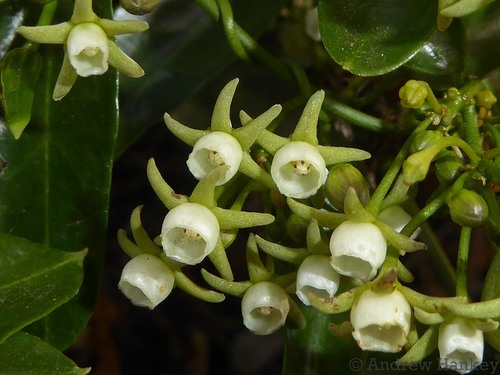
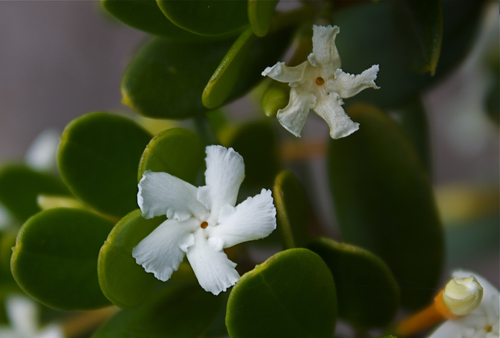
Its flowers are arranged in cymes. Each flower forms an anticlockwise twisted star shape, with petals fused at the base to create a corolla tube. Corolla lobes, the tips of the petals, are white to cream, while the corolla tube is orange. Flowers measure 0.4 cm to 0.5 cm in diameter, and 0.7 cm to 1.1 cm in length. An inflorescence can hold up to 8 flowers, with the central flower maturing first. This species flowers during spring and autumn, with peak flowering between October and December. Alyxia buxifolia produces dicot pollen grains, which have two large circular pores. The grains are unevenly barrel-shaped, with one side longer and less curved than the other, and are classified as large. All plants are hermaphrodite, with no unisexual flowers produced.
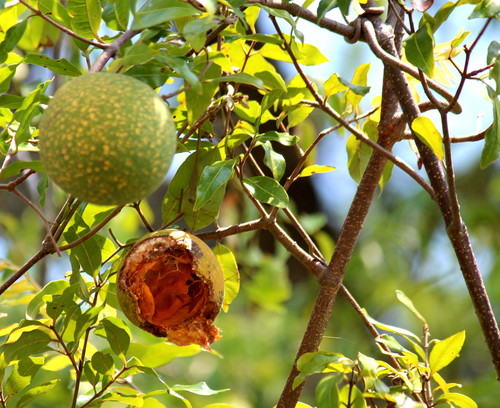
When ripe, the fruit of Alyxia buxifolia is a drupe that ranges in colour from orange to red. This small, ellipsoid fruit measures 0.4 cm to 0.8 cm in diameter and 0.5 cm to 0.7 cm in length, and is typically single-seeded. Usually, only one or two fruits develop from each flower. The fruit is toxic to humans.
Alyxia buxifolia is found across southern Australia. It occurs along the far south coast of New South Wales, and extends along the coast of Victoria. It also grows on the north and north-eastern coasts of Tasmania. In addition to coastal areas of South Australia, it grows in inland areas including the Nullarbor Plains and Flinders Ranges. It can also be found in both coastal and inland areas of southern Western Australia.
This shrub occupies a wide range of habitats, and is most common in coastal ecosystems, especially on sea cliffs, sand dunes, and in areas exposed to strong winds. It also grows in inland areas ranging from high-rainfall zones to semi-arid, low-rainfall regions. In these areas, it is most often found in coastal heathlands and sand dune ecosystems, where it is frequently the dominant shrub. It also grows in several forest types, including littoral forests, eucalypt forests, and open forests. It has been recorded growing in open to sparse scrublands, including mallee scrub ecosystems. It grows at altitudes from 0 m to 1000 m above sea level.
It can grow in a wide variety of soil types, including sand, limestone and limestone-derived soils, loams (including red loam and sandy yellow loam), and soils dominated by quartz rock. Soils supporting this species have neutral to alkaline pH. Alyxia buxifolia is a hardy species that tolerates coastal conditions including salt spray and drought, and can survive mild frost, though it is typically damaged by moderate to severe frost.
Ecologically, Alyxia buxifolia provides habitat for a range of animals including birds (such as the blue-breasted fairy wren), small mammals, and reptiles. Its fruit is a food source for many coastal birds, and its flowers produce nectar and pollen that feed invertebrates including Australian native bees. This species is a known host for the fungus Puccinia alyxiae, and is parasitised by Alyxiaphagus picturatus. Before European colonisation, the bark of Alyxia buxifolia was used by Australian First Nations people to treat dysentery.