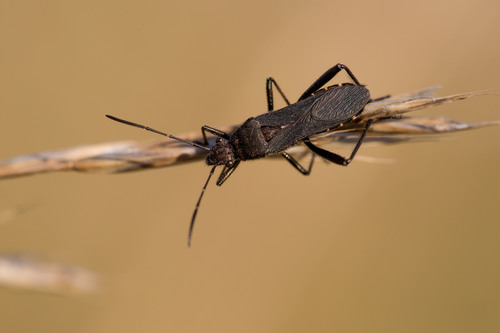
About Alydus calcaratus (Linnaeus, 1758)
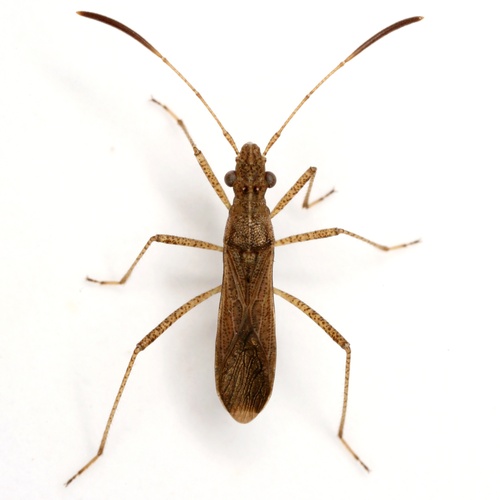
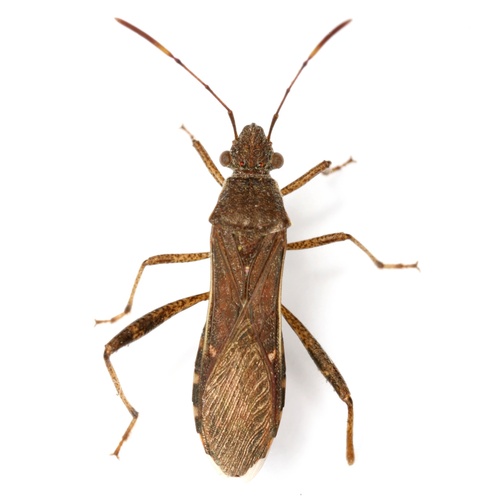
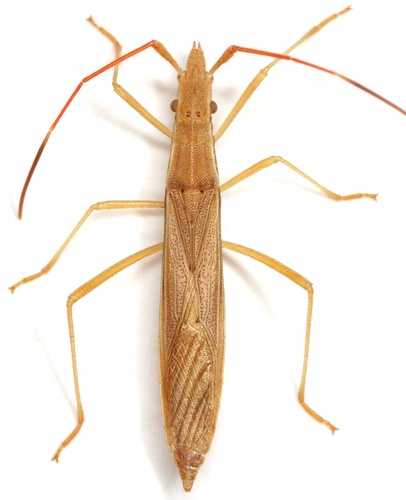
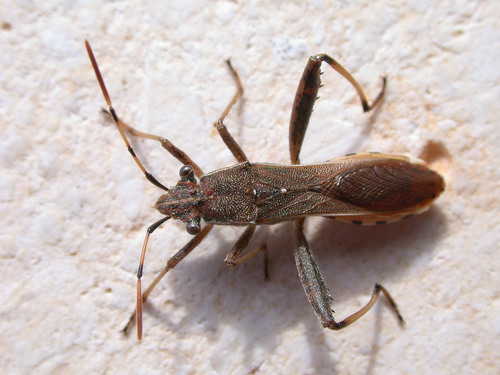
Alydus calcaratus (Linnaeus, 1758) is a species of bug with a Holarctic distribution. Its range extends from the British Isles across almost all of Europe, reaching eastern Siberia and China. It also occurs in northern North America, spanning from Alaska and Québec across the United States to Wyoming. Outside the Alps, it is the only species from its family present in northern Central Europe. Alydus calcaratus is a large oblong bug, measuring 10.0 to 12.0 mm long, that is mainly blackish in color. Its head is the same width as its pronotum, and the rear corners of the pronotum are rounded. Male individuals have thickened hind femora that bear several strong spines on the underside. Like all other species in the family Alydidae, its antennae have four segments, with the fourth segment being curved. The body is blackish, and the dorsum of the abdomen has a bright orange patch that is only visible when the bug is in flight. Alydus calcaratus resembles spider-hunting wasps such as Arachnospila. This bug is phytophagous; both adult imagines and nymphs feed mostly on fallen seeds of various legumes in the family Fabaceae, especially species from the genera Sarothamnus, Cytisus, Genista, and Ulex. Feeding on vertebrate carrion and faeces has also been observed for this species. In Germany, adult imagines can be observed as early as the middle or end of June. Most individuals are seen from early August to mid-September, and the last sightings occur in October. Mating takes place from July to September, and nymphs have been found from May to August. Information about the nymphs' way of life is contradictory. It has been reported that nymphs live in ant nests, but the nature of the relationship between the nymphs and ants remains unclear. The species' habitat includes heaths, dry grassland, dry areas with light soils, and sand dunes.