About Alucita montana Barnes & Lindsey, 1921
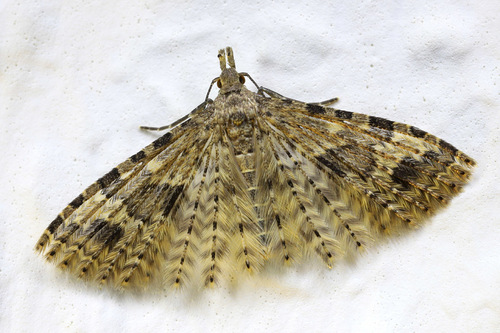
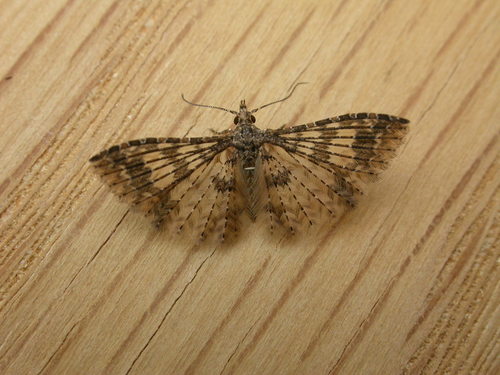
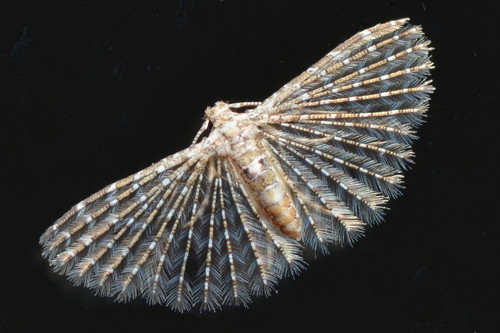
Alucita montana, commonly known as the Montana six-plume moth, is a moth species belonging to the family Alucitidae. It was formally described by William Barnes and Arthur Ward Lindsey in 1921. This moth is found in North America, with a range extending from southwestern Quebec and Vermont west to British Columbia, and south to Arizona, California, and Texas. Its wingspan measures 11–16 mm (0.43–0.63 in). The forewings are crossed by a wide median band that is narrowly margined with white, and this band forks across the first two forewing lobes. A second band located closer to the base of the first lobe is not distinctly visible on other lobes. There is also an additional subterminal band that is narrower on the first two lobes. Between this subterminal band and the median band sits a heavy costal spot that does not reach the inner margin of the first lobe. All of these dark markings on the forewings are margined with white. The overall ground color of the moth is grayish tawny. All the markings and the tips of the lobes are very dark brown. The hindwings have a checkered pattern formed from dark brown, tawny, and white. Larvae feed on Symphoricarpos species in the northern portion of this moth's range, and on Lonicera species in California.