About Althaea officinalis L.
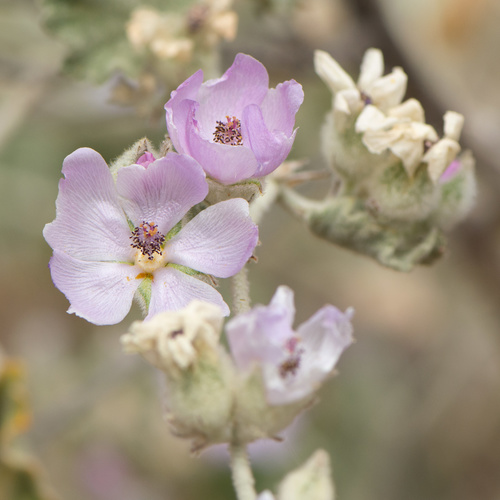
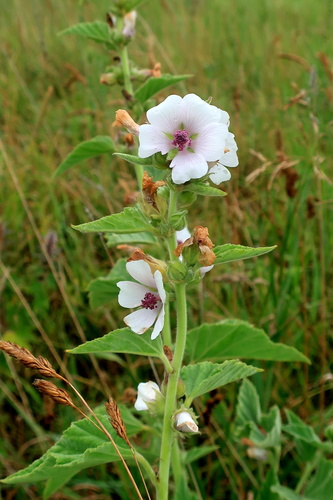
Althaea officinalis L. is a herbaceous perennial plant that reaches up to 180 cm (6 ft) in height, and produces only a small number of lateral branches. The entire plant is covered in soft, stellate hairs, with the densest covering found on the leaves. Leaves are broadly triangular to oval, often bearing 3–5 shallow lobes, have irregularly toothed margins, and bases ranging from cordate to cuneate. Leaf size varies widely, growing up to 100 mm (4 in) long and 75 mm (3 in) wide. Leaves are arranged alternately along the stem, lack stipules, and grow on petioles that reach up to 45 mm (1.75 in) in length. Inflorescences form both in leaf axils and at the stem apex, consisting of panicles holding between 1 and many flowers. The flowers are actinomorphic, with 5 lilac or pink petals up to 2 cm (0.8 in) long, and 5 green sepals that are much shorter than the petals and fused at their base. A cup-shaped epicalyx sits below the petals, with 6–9 narrow triangular lobes that are half the length of the sepals. Purple stamens are fused into a tube; the anthers are kidney-shaped and single-celled. A single style extends out above the stamen tube. Flowering occurs in August and September. After flowering, it produces flat, round fruits commonly called "cheeses", matching the fruit form seen in other species of this order. The whole fruit is a schizocarp around 1 cm (0.4 in) in diameter, which splits into approximately 20 kidney-shaped mericarps (seeds) that are around 2 mm (0.08 in) long. Common mallow is often colloquially called "marsh mallow", but true marsh mallow (Althaea officinalis) can be distinguished from all other mallows growing in Great Britain by three key traits: the numerous 6–9 cleft divisions of its outer calyx, the dense hoary down covering its stems and foliage, and its numerous panicles of blush-coloured flowers that are paler than the flowers of common mallow. Its perennial roots are thick, long, and tapering, very tough and pliant, whitish yellow on the outside, and white and fibrous internally. The leaves, flowers, and root of A. officinalis (marshmallow) have been used in traditional herbal medicine. This healing use is reflected in the genus name, which comes from the Greek word althainein (ἀλθαίνειν), meaning "to heal". The Latin specific epithet officinalis is used for plants with culinary or medicinal value. Traditionally, marshmallow is used to relieve irritation of mucous membranes, including use as a gargle for mouth and throat ulcers, and for gastric ulcers.