About Alternanthera philoxeroides (Mart.) Griseb.
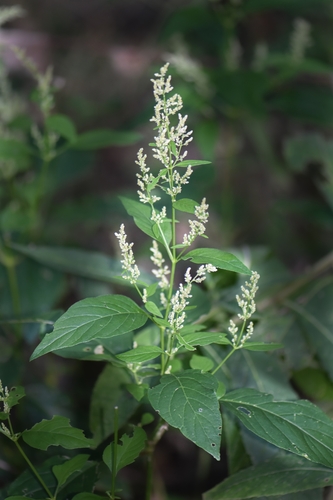
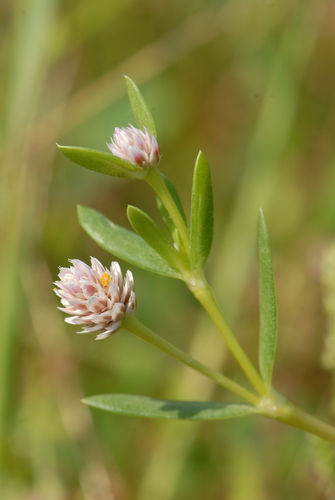
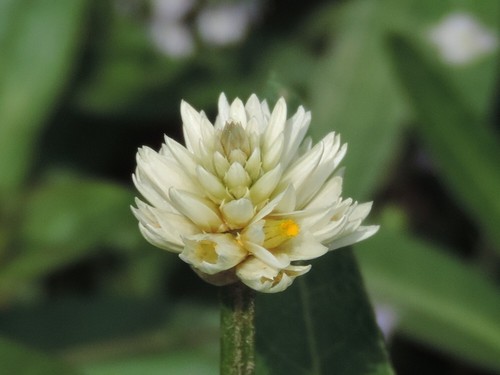
Alternanthera philoxeroides (Mart.) Griseb. can grow successfully in both dry and aquatic environments. This herbaceous plant has a short-lived shoot system, and has key identifying features: irregular or sprawling hollow stems, simple leaves arranged in an opposite pattern growing from its nodes, and whitish papery flowers that develop along its short stalks. It produces horizontal stems called stolons that can grow up to 10 metres (33 ft) long. Its hollow stems let it float easily, leading to large accumulations of stems that form dense mats on water surfaces. Its small, white bisexual flowers grow on dense axillary spikes, a specific type of raceme. The presence of a peduncle is a key trait that sets this species apart from Alternanthera sessilis, which has sessile inflorescences. Although seed production has been recorded in A. philoxeroides’s native range, there is currently no documented evidence of viable seeds of this species occurring in areas where it has been introduced. This plant has an intricate root system that can either hang freely in water to absorb nutrients, or penetrate directly into soil or sediment to take up nutrients from below.
As an invasive plant, A. philoxeroides relies entirely on vegetative reproduction and dispersal in invaded areas where it has become established. In its native geographic range, the species spreads by producing viable seeds. However, within non-native ranges, it rarely produces viable seeds. Instead, A. philoxeroides reproduces through fragmentation: the plant can regenerate fully from small portions of stems or small leaf cuttings. These small plant fragments can be dispersed by both human activity and natural processes. Once dispersed to a location with suitable ecological conditions, the fragments can take root and regenerate into new plants.