About Alstroemeria pelegrina L.
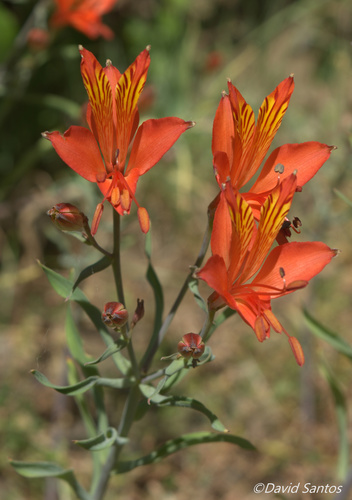
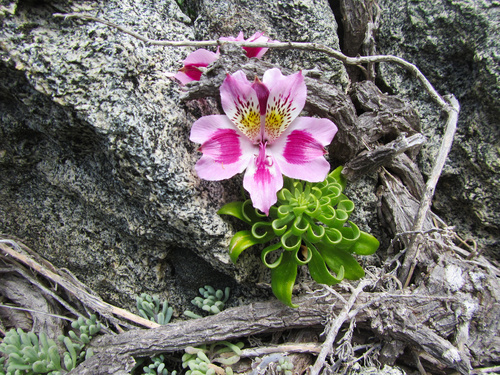
Alstroemeria pelegrina L. has stems that grow 20 to 60 cm tall. The upper sections of the stems are glabrous (smooth), while the lower sections are covered in scales. It has cylindrical, branched, elongated rhizomes that bear long, thin roots. Leaves emerge from the upper third of the stem; they are vivid green, arranged in a spiral, and twisted so their tips point to the side. The flowers are large and showy, with tepals 4.5–5.5 cm long. Tepals are an intense pink shade with a purple center. The stamens have purplish anthers. The glabrous ovary has 6 prominent ribs, and the plant produces brown, spherical seeds. Alstroemeria pelegrina is endemic to the Norte Chico and central regions of Chile, and also occurs in Peru. Its range in Chile extends from Los Vilos, Choapa Province, Coquimbo Region, south to Punta Curaumilla, Valparaíso Province, Valparaíso Region, an area with a Mediterranean littoral climate. A large population grows along the coast between Los Molles, Valparaíso, and Pichidangui, near Los Vilos, where the plant has the local name mariposa de Los Molles (Los Molles butterfly). Its preferred habitat is rocky areas and coastal cliffs at the high tide level. This species blooms each year between October and December, and fruits develop after the end of October. It was the first Alstroemeria species brought to Europe, where cultivation began in 1744. It is hardy to USDA zones 10a–11. In the United States, it is grown in California, Louisiana, Texas, and Florida.