About Alstonia macrophylla Wall. ex G.Don
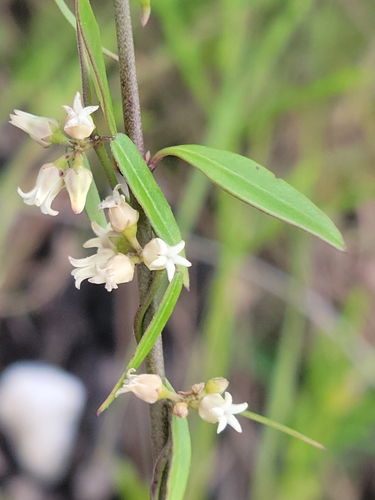
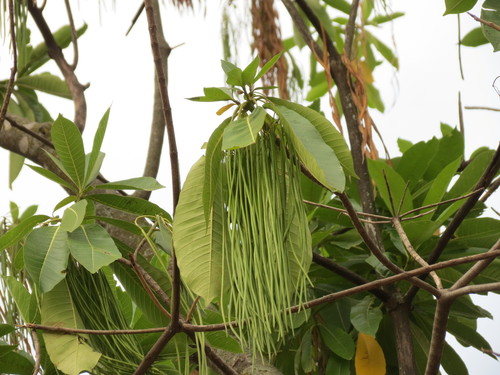
Alstonia macrophylla Wall. ex G.Don is a tree species with a straight trunk and a tall, narrow crown. It can reach up to 30 meters in height. Its trunk and branches produce white latex, and its bark is smooth and light grey. Leaves grow in whorls of three to four; they are simple, penni-veined, membranous, and glabrous on the upper surface. Leaf blades measure 10 to 50 centimeters long and 5 to 15 centimeters wide, are widest at or above the middle, and have a cuneate base. The flowers are roughly 7 millimeters in diameter, white, feature a narrow corolla tube, and grow at the tips of twigs. The fruits reach around 30 centimeters in length, are green, and contain many small hairy seeds that are wind-dispersed over long distances. The heartwood is yellowish, has a straight and shallowly interlocked grain, and has a moderately fine to rather coarse texture.
Alstonia macrophylla is native to Indonesia (Kalimantan and Sulawesi), Malaysia, the Philippines (where it is called batino in Tagalog), Thailand, and Vietnam. It has been introduced to Sri Lanka, where local Sinhalese people know it as hawari nuga.
This species grows in a wide variety of habitats, occupying both undisturbed and disturbed areas from sea level up to 2900 meters in altitude. It grows near the coast behind mangrove forests, and also in mixed dipterocarp forests. It most commonly grows on ridges and hillsides with soils ranging from sandy to clayey, and can also grow in ultrabasic and limestone soils.
The timber of Alstonia macrophylla is of higher quality than that of Alstonia scholaris, and is less susceptible to attack by boring insects. It is used to make roof beams, frames, poles, and toys. As a fast-growing tree that tolerates a wide range of habitats and soil types, it has been used for reforestation projects in Sri Lanka.