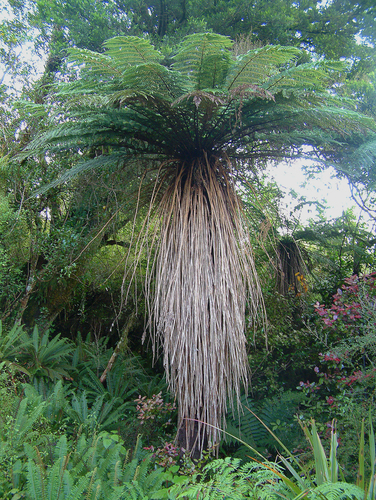
About Alsophila smithii (Hook.fil.) R.M.Tryon
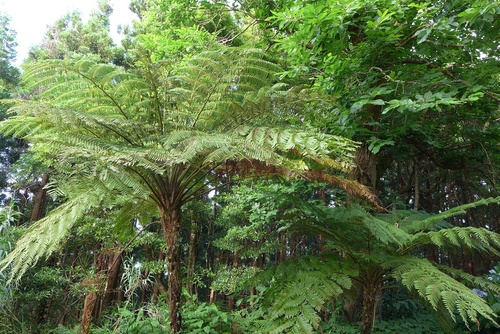
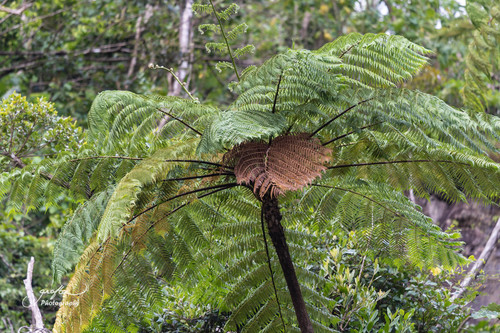
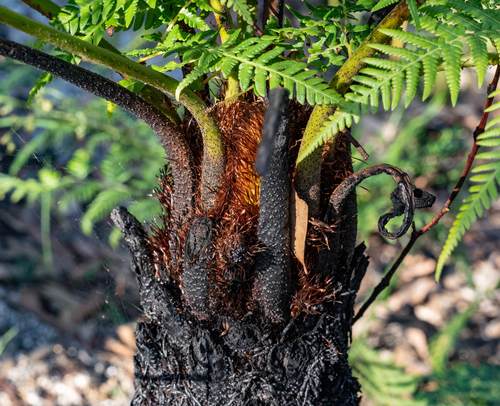
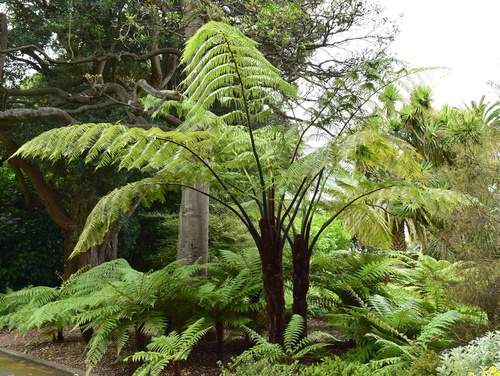
Alsophila smithii is an understory tree fern that grows up to 8 meters tall. Unlike other well-known members of its genus, it typically does not grow tall enough to reach the forest canopy. It grows slowly, and is not a strong competitor except at higher altitudes. Like related tree ferns, it has rough scales along its rachis and trunk. A distinctive characteristic of this species is that it retains dead fronds to form a skirt. Unlike the skirt of another skirt-forming tree fern, Dicksonia fibrosa, this skirt is made only of the central rachis (not the entire frond), so it is more compact. This species produces large numbers of very soft, delicate-looking fronds that spread horizontally from the plant's crown, and reach 2 to 2.5 meters in length. The natural distribution of Alsophila smithii includes all major islands of New Zealand: the North Island, South Island, Stewart Island / Rakiura, the Chatham Islands, and extends south to the Auckland Islands. It is common in montane forest, and populations in the southern parts of its range also grow in lowland forest. In the Westland forests of the South Island, A. smithii grows in the understory of certain broadleaf/podocarp forests. In cultivation, Alsophila smithii is damaged by exposure to wind, sun, and frost, and is prone to drying out, but can be grown successfully in sheltered locations. Traditionally, the pith of this fern was used as a source of starch. Because the pith is high in resin, it was likely only a food of last resort, or at least an acquired taste. The trunks of this tree fern have been used as rough building material, fencing, and makeshift trackwork.