About Alsophila dregei (Kunze) R.M.Tryon
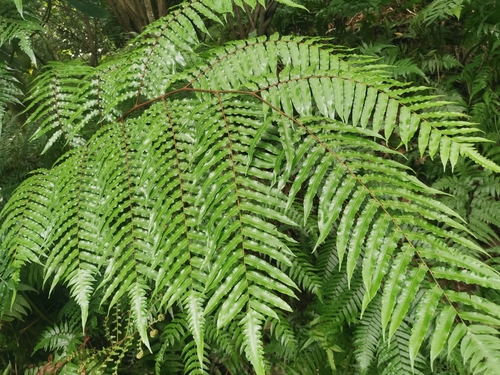
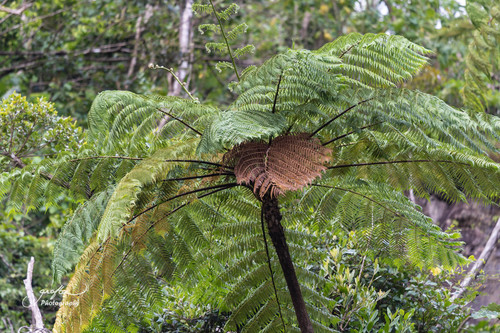
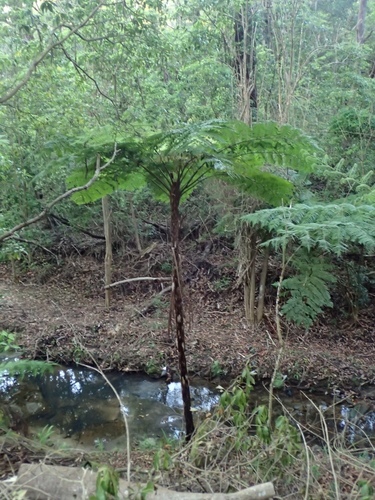
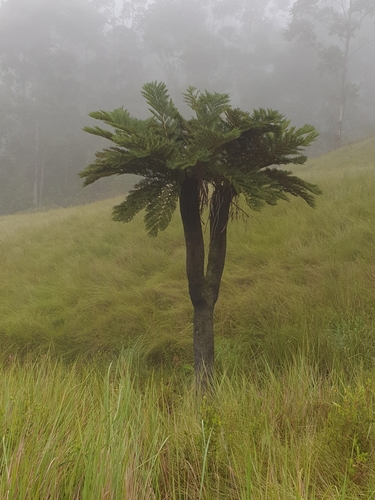
Key characteristics of Alsophila dregei. This species has an erect, stout trunk that reaches up to 5 metres (16 ft) in height and 20–45 cm in diameter. It is a variable species, typically with a thick trunk and dense crown, and occasional branching is observed. Its fronds are tripinnate, only rarely bipinnate, and may grow up to 3 m in length. The fronds are characteristically large and arching, and the lowest pinnae are usually reduced. The upper surface of the fronds is glabrate, while the lower surface may be tomentose. The rachis and stipe are brown and have a rough texture, and the stipe is covered in brown scales. Up to twelve sori form per group per pinnule. Distribution and habitat. Alsophila dregei is widely distributed across sub-Saharan Africa. In west and west-central Africa, it is found in Guinea, Sierra Leone, Ghana, Nigeria, and Cameroon; in eastern and southern Africa, its range extends from the Democratic Republic of the Congo and Uganda to South Africa. It is also native to Madagascar. In West Africa, this species grows in mountain and plateau grasslands and woodlands, at elevations between 760–2,260 m (2,500–7,400 feet). It grows on stream banks, along forest margins, and in grasslands. It often grows in open areas in full direct sunlight, as long as sufficient moisture is available. It is most common at elevations between 900–1,800 metres (3,000–5,900 ft). Wild-growing Alsophila dregei is known to be fire resistant. Cultivation. Alsophila dregei is an uncommon ornamental plant in cultivation, particularly in South Africa and Australia. For successful cultivation, plants should be given shelter, grown in rich humus, and provided with a constant supply of moisture. This species can survive light frosts with only minor damage.