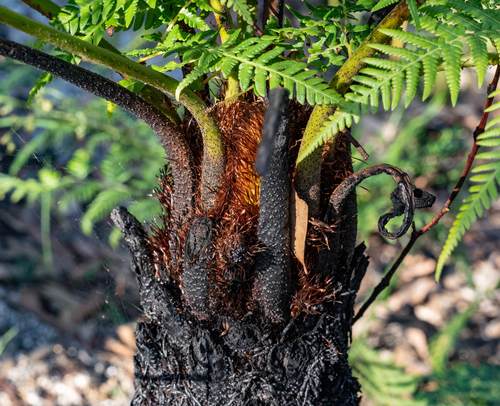
About Alsophila dealbata (G.Forst.) C.Presl
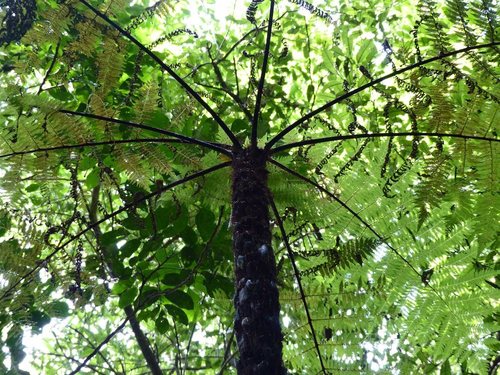
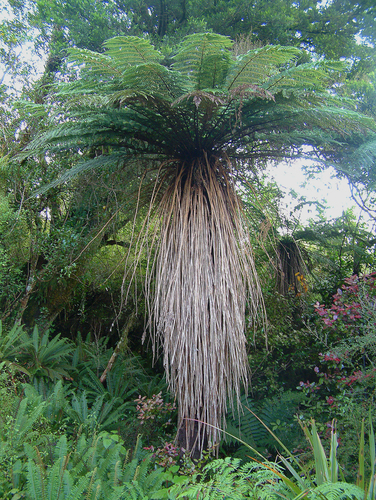
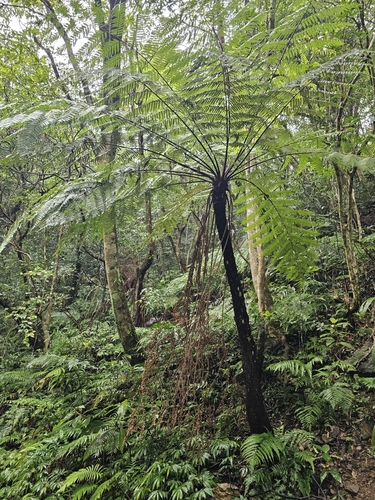
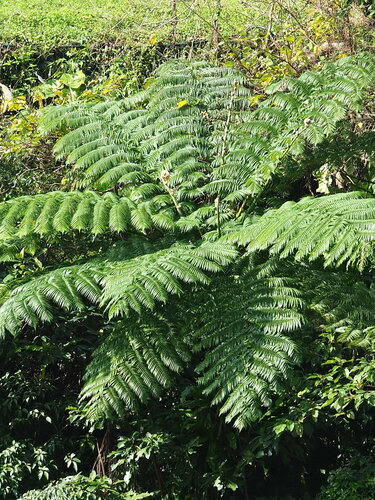
Alsophila dealbata, commonly called the silver fern or ponga, is a tree fern species. This fern typically grows to heights of 10 metres (33 ft) or more, and it very rarely grows in a creeping form. It has a dense crown; mature fronds can reach up to 3 metres (9.8 ft) long and 1 metre (3 ft 3 in) wide, and feature a distinctive silver-white colouration on their undersides. Fronds may be either bipinnately compound or tripinnate. Younger plants have less intensely silvery underside colouration, or patchy silver colour, and juvenile ferns have pale green undersides. Its characteristic silver frond undersides made it useful for laying along walking tracks to guide travel at night. Its scales are dark brown, often twisted and glossy. Rhizomes are very rarely prostrate, and are usually erect, forming a woody trunk that can grow up to 12 metres (39 ft) tall, with a diameter between 160 to 450 millimetres (6.3 to 17.7 in). The trunk is covered in light brown or white projecting stipe bases, and bears scales near its apex. This species arrived relatively recently in New Zealand’s geological history during the Pliocene epoch, approximately 5.0–1.8 million years ago. It naturally occurs on the main islands of New Zealand, though it is absent from the west and south regions of the South Island; it is also native to the Chatham Islands east of New Zealand, and to Lord Howe Island. It has become naturalised in Ireland. Its primary habitat is the subcanopy of drier forests and open scrub. It is occasionally found on bush margins, in more open areas, and has been recorded growing among rushes in a dune slack. The fern grows well in well-drained humus; once established, it can tolerate drier conditions. It grows best when sheltered from wind and requires protection from frost. Evidence of large amounts of macro-charcoal in top soil layers suggests that related Alsophila tricolor establishes in areas affected by human-caused fires. In modern New Zealand landscaping, ponga logs are widely used to build retaining walls and create garden edging. The silver fern has been used as a symbol by New Zealand national sports teams in various stylised forms ever since it was first worn by players of the 1888–89 New Zealand Native football team that toured Britain. New Zealand’s national netball team is named the Silver Ferns, and most other New Zealand national women’s sports teams use nicknames based on the term “Ferns”: examples include the Black Ferns (women’s rugby union), Tall Ferns (women’s basketball), and Football Ferns (women’s association football). The silver fern is also widely used as part of the official symbols of New Zealand’s Olympic teams. In 1991, the New Zealand Rugby Football Union registered trademarks for the name “All Blacks” and its own stylised fern, but sought a broad scope of protection that included registering any “fern” design. In 2005, after a four-year legal case, the union failed in its attempt to prevent all other parties from using any fern logo on black jerseys.