About Alseuosmia quercifolia A.Cunn.
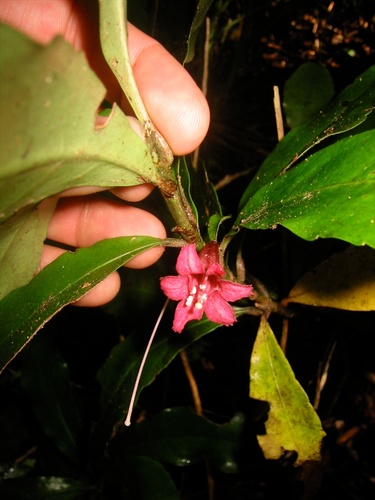
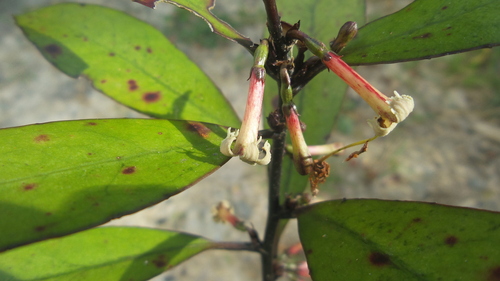
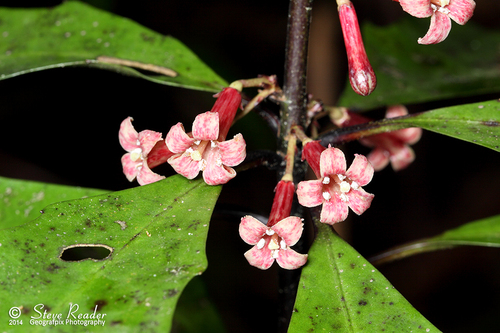
Alseuosmia quercifolia is a shrub that grows up to 2.5 meters tall. It has reddish-brown branches, with new growth that is crimson in color. Its bright green, glossy leaves attach to 1 cm long brown petioles, and leaf shape varies widely between individual plants. It flowers from September to October, producing 2 to 6 flowers per inflorescence; each flower contains both male and female reproductive parts. Flower color varies from creamy-white to pink, and flowers are strongly fragrant. Each flower has a 5-lobed calyx, with a protruding 11 mm long corolla tube. The ellipsoid, plum-red fruits are 2.8 to 9.7 mm long, and mature in autumn, with fruiting occurring from March to May. Each fruit contains 1 to 17 seeds, with an average of 6 seeds per fruit and an average individual seed mass of 0.19 g. Alseuosmia quercifolia is endemic to the North Island of New Zealand, where it occurs only north of 38˚S, and is absent from the Coromandel and Bay of Plenty. It has been recorded on Great Barrier Island and Waiheke Island, and is most common in lowland forest of the Waikato region. It prefers habitats with annual rainfall over 1100 mm, south-facing slopes, cool conditions, and free-draining soil. Many vascular plant species grow in association with Alseuosmia quercifolia, and it is consistently found growing alongside tawa, hangehange, rewarewa, mahoe, and supplejack. This shrub is commonly browsed by invasive pests including brushtail possums, feral goats, fallow deer, and potentially hares. The cicada Melampsalta cingulata lays its eggs on A. quercifolia stems, which kills the stem above the egg-laying site. Various slugs and snails damage the plant’s leaves, as do cocoons of the common leaf-roller. While the species is now rare, pollination has been recorded from hihi and korimako. It is suspected that moths also contribute to pollination, with the species Epyaxa rosearia specifically identified as a potential pollinator. Its berries are dispersed by kōkako and kererū; historically, they were dispersed by moa and kākāpō. Alseuosmia quercifolia can be cultivated from both seed and cuttings. Seeds germinate in spring, while cuttings develop roots in 5 to 8 weeks. Seedlings are easily identified by their red petioles and white veins. Growing from cuttings has a reported 100% success rate. Even under ideal conditions of low light, 13˚C temperature, and pre-soaking in Gibberellic acid, cultivation from seed only has a 65% success rate. It grows most easily in pots. When planted out, it requires partial shade and rich soil, but the species is prone to sudden collapse when grown in cultivation.