About Alpinia caerulea (R.Br.) Benth.
Alpinia caerulea is a rhizomatous plant with arching stalks that reach 2–3 m (6 ft 7 in – 9 ft 10 in) in length. Each stalk bears multiple large, alternately arranged leaves that grow up to 40 cm (16 in) long and 10 cm (3.9 in) wide. The leaves are either sessile or have a very short petiole; they have a glossy dark green upper surface, a lighter green lower surface, and an acuminate tip.
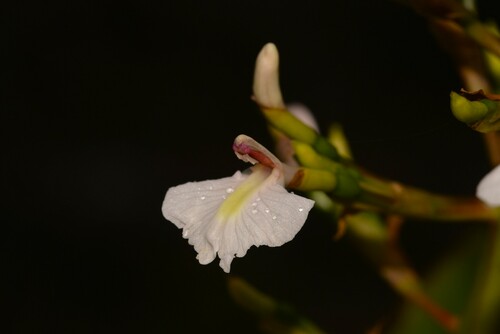
The inflorescence grows at the end of stalks, reaching up to 30 cm (12 in) long and holding many white flowers. The fruit is a blue, globose capsule around 1 cm (0.39 in) in diameter, with a thin, brittle casing. The capsule holds numerous black seeds embedded in white pith. This species flowers from September to April, and its fruit can ripen in any month of the year.
Commonly called native ginger, Alpinia caerulea is endemic to New South Wales and Queensland, Australia. Its natural range extends from the Gosford district north along the coast to the tip of Cape York Peninsula and the islands of the Torres Strait. It grows in coastal and sub-coastal rainforest and wet sclerophyll forest, and is commonly found beside waterways. It occurs from sea level up to around 1,400 m (4,590 ft) in elevation, and it is thought the species may also grow in New Guinea.
Ecologically, Alpinia caerulea is a host species for larvae of the banded demon butterfly (Notocrypta waigensis). Its fruits are eaten by a range of birds including brush turkeys (Alectura lathami), southern cassowaries (Casuarius casuarius), crimson rosellas (Platycercus elegans), king parrots (Alisterus scapularis), regent bowerbirds (Sericulus chrysocephalus), satin bowerbirds (Ptilonorhynchus violaceus), and Lewin's honeyeaters (Meliphaga lewinii). Two species of Australian rodents also consume its fruit: giant white-tailed rats (Uromys caudimaculatus) and fawn-footed melomys (Melomys cervinipes).
For the Kuku Yalanji people of far northern Queensland, this plant has many traditional uses. The fruit, rhizomes and new shoots are edible, with new shoots having a mild ginger flavour. The white flesh surrounding the seeds is crisp and acidic; Indigenous Australians chewed this flesh on long walks to stimulate salivary glands and moisten the mouth, usually discarding the seeds after chewing. Leaves were used to cover shelters and wrap meat for cooking in earth ovens.