About Alphitonia excelsa (Fenzl) Benth.
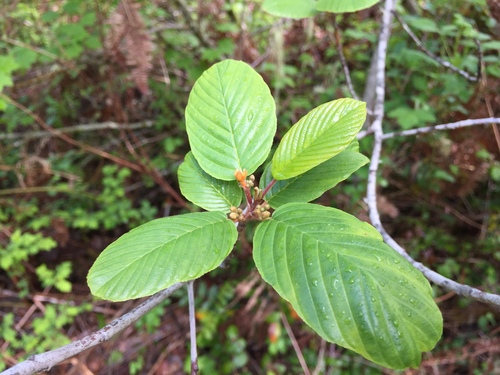
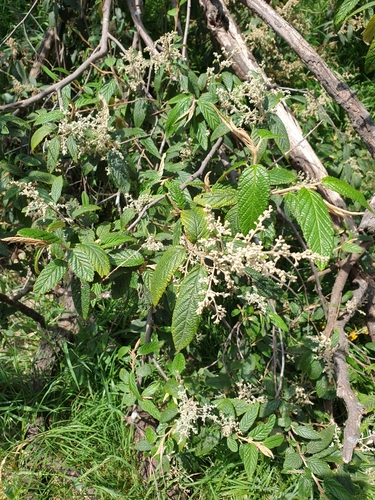
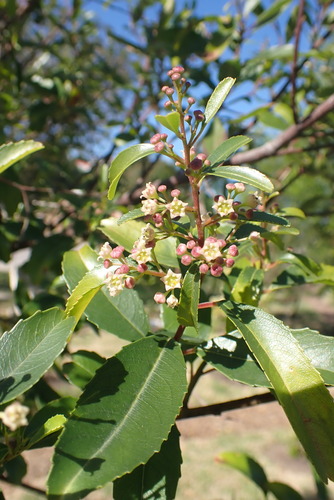
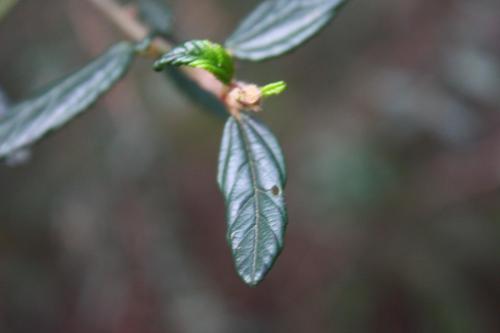
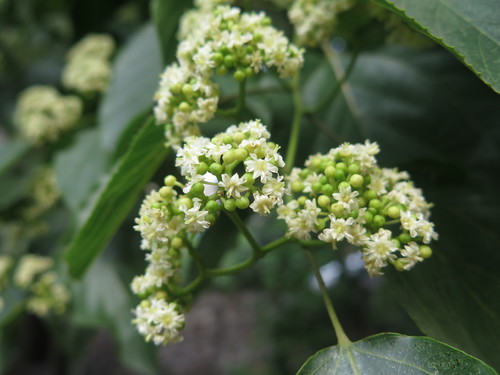
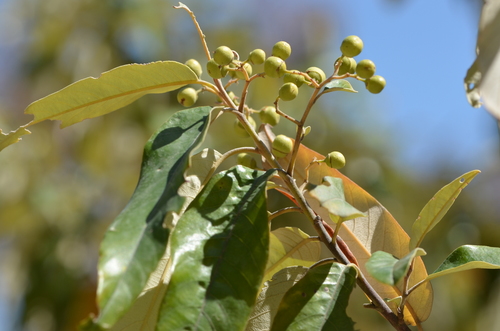
Alphitonia excelsa (Fenzl) Benth., commonly called red ash, is a tree that reaches 7–25 metres (23–82 ft) in height and 5–10 metres (16–33 ft) in spread. Mature large trees grow with a spreading, shade-producing form and have an overall greyish green appearance. Its alternate leaves measure 5–14 cm (2–5.5 in) long and 2–5 cm (1–2 in) wide; they are dark glossy green on the upper surface and silvery with fine hairs underneath, creating an attractive contrast when stirred by wind. The trunk and larger branches have fissured grey bark, while smaller branches have smoother grey or white bark. Small greenish white flowers bloom in late autumn and early winter, and have a fragrant scent in the evening. These flowers are followed by globular dark fruit around 1.5 cm (0.6 in) in diameter that contain two seeds. Bruised young shoots release a characteristic sarsaparilla odour.
This species grows in eucalypt forests, eucalypt and acacia savannas, gallery forests, and rainforests. Its range extends from Mount Gulaga (previously known as Mount Dromedary) in New South Wales, northwards along the coast and inland to the Pilliga scrub, through Queensland and the Northern Territory, and into the northeast of Western Australia. Inland-growing forms can be stunted. Alphitonia excelsa prefers sandy soils.
Ecologically, it is a food plant for the caterpillars of the moonlight jewel (Hypochrysops delicia) and the small green-banded blue (Psychonotis caelius taygetus). In cultivation, Alphitonia excelsa grows quickly. It is an Australian ornamental tree, with some specimens having high visual appeal. It may be used in amenity planting as a street tree that provides shelter. Its tough timber, which is light red or brown in colour, has been used for boat-building and cabinet making. It can act as a fodder plant for sheep and cattle, and is a useful pioneer species for bush regeneration. Indigenous Australians used its leaves as soap, due to the plant’s high saponin content.