About Alphestes immaculatus Breder, 1936
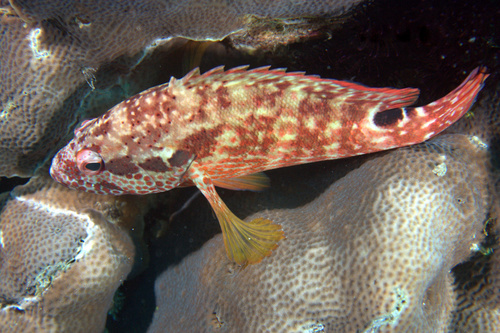
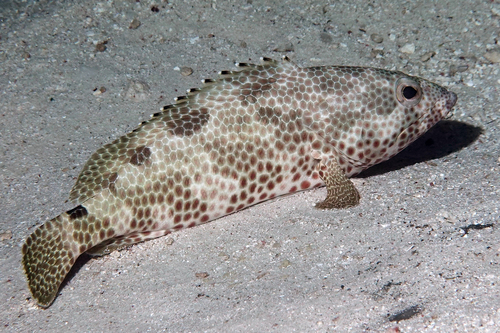
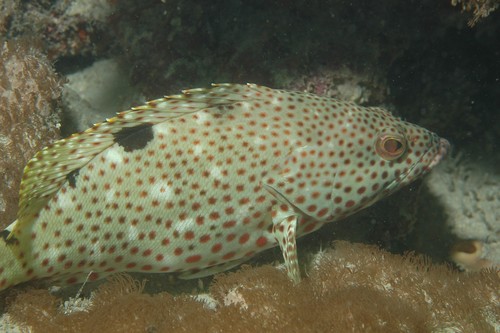
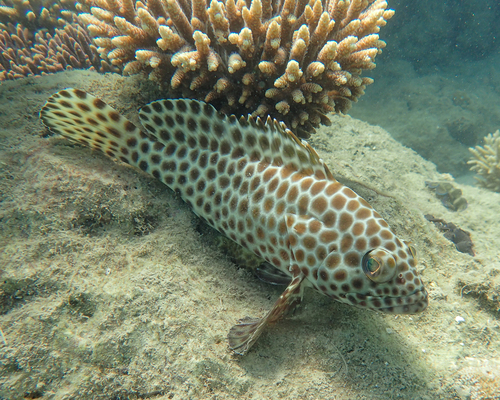
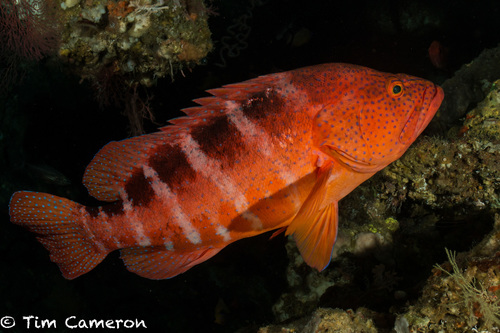
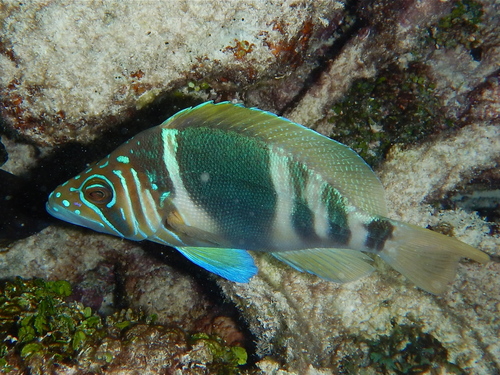
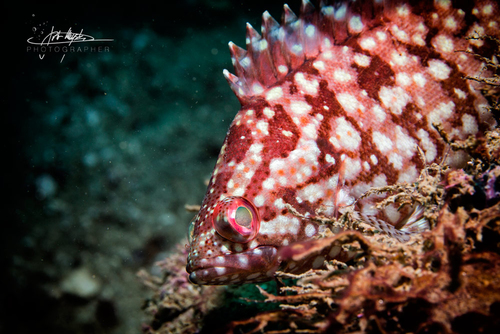
Alphestes immaculatus, described by Breder in 1936, has a strongly compressed, deep body, large eyes, a short snout, and a straight forehead. Its dorsal fin has 11 spines and 17 to 19 soft rays, while its anal fin has 3 spines and 9 soft rays. It has a rounded preopercle with a clearly serrated rear edge, and a large spine that projects downward and forward at the preopercle's angle; this spine is usually covered by skin. The head and body are marbled reddish brown, with indistinct bars and small dark and pale spots scattered across the head, body, and the dorsal, anal, and caudal fins. The pectoral fins have 7 or 8 irregular horizontal rows of small dark spots across their surface. The maximum recorded total length of this species is 30 centimetres (12 inches), but most individuals are typically around 18 centimetres (7.1 inches) long. This species is distributed in the Eastern Pacific Ocean, ranging from southern Baja California and the Gulf of California south to Peru. It is also found around Mexico's Islas Marías and Revillagigedos, the Galápagos, Malpelo Island in Colombia, and Cocos Island in Costa Rica. Alphestes immaculatus is a secretive, well-camouflaged shallow water species that inhabits seagrass beds and rocky reefs at depths between 1 metre (3 ft 3 in) and 50 metres (164 ft 1 in). During the day, it remains hidden in crevices or rests among seaweed, using its cryptic colouration to avoid detection by predators. Occasionally, individuals will partially bury themselves in sand. They become active at night, foraging for their main prey: benthic invertebrates and small fishes. This is normally a solitary species, though groups of up to 6 individuals have been observed. It can live for up to nine years. Muscle hepcidin expression may play an important role in the fish immune response. Basal expression of the HAMP1 gene in the muscle tissue of A. immaculatus may represent a protective mechanism that acts against pathogen invasion before a strong immune stimulus occurs.