About Aloysia deserticola (Phil.) Lu-Irving & N.O'Leary
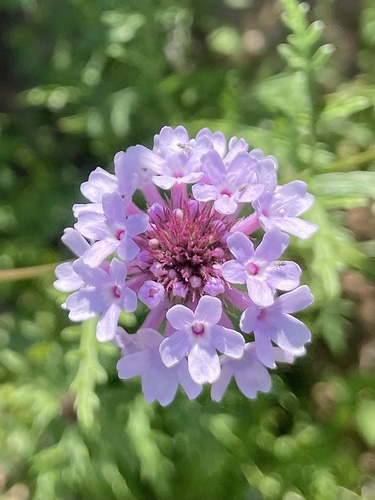
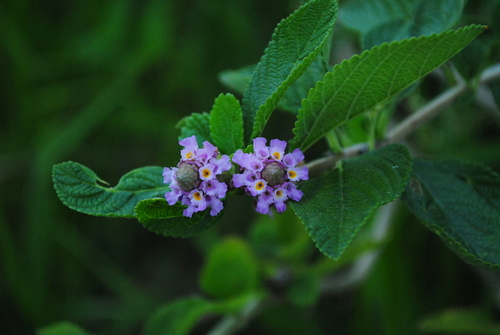
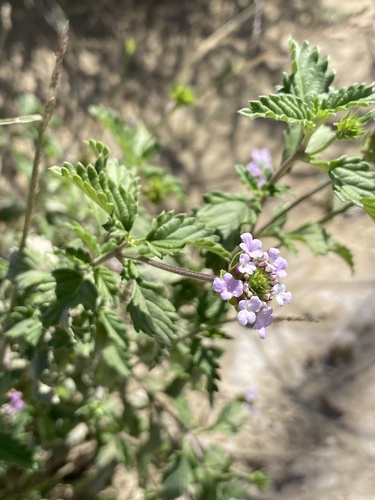
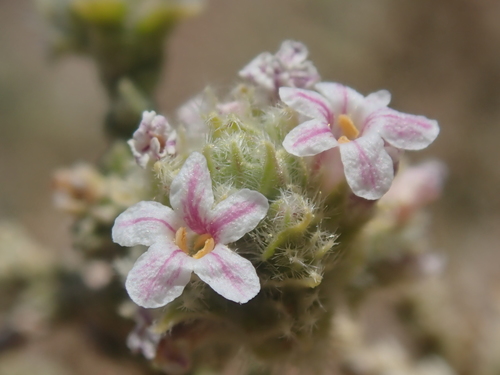
Aloysia deserticola (Phil.) Lu-Irving & N.O'Leary is a branched shrub that reaches 0.4–1.0 metres (1.3–3.3 ft) in height, with cylindrical branches. It produces opposite yellow-green leaves that have a brain-like appearance; leaves measure roughly 1.5 millimetres (0.059 in) long and 1.5–2 millimetres (0.059–0.079 in) wide. Leaves are trilobed, more or less rhomboidal in overall shape, with bumps on the abaxial surface and a distinct groove running along each lobe. The leaf epidermis has a thick cuticle that becomes thinner near the top of each groove. The adaxial leaf surface is covered in thick, whitish trichomes on its upper half, and is hairy on its lower half. The plant bears spiciform, terminal, sessile racemes that range from globose to cylindrical in shape, and measure 12–15 millimetres (0.47–0.59 in) long. It produces lilac flowers that are 3–3.5 millimetres (0.12–0.14 in) long. Commonly called rica-rica, this species is frequently used as an aromatic herb in Northern Chilean cuisine. It is used as a condiment and spice, and to prepare herbal infusions. Its dried leaves and branches are used to season food, add flavor to mate and tea, are an ingredient in the drink called "rica-rica sour", and are used to make artisanal ice cream. In traditional medicine practiced in communities including San Pedro de Atacama, Toconce, Socaire, and Ollagüe, rica-rica is used to treat indigestion, and as an antispasmodic to relieve symptoms of stomach problems. Infusions made from its leaves are also used to treat circulatory and kidney problems.