About Alouatta seniculus (Linnaeus, 1766)
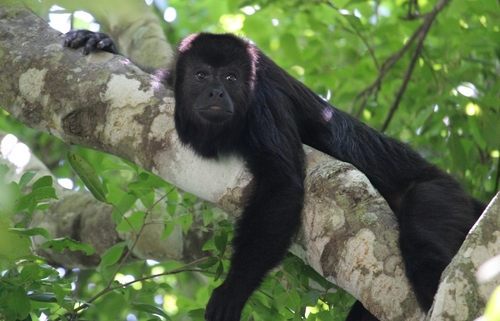
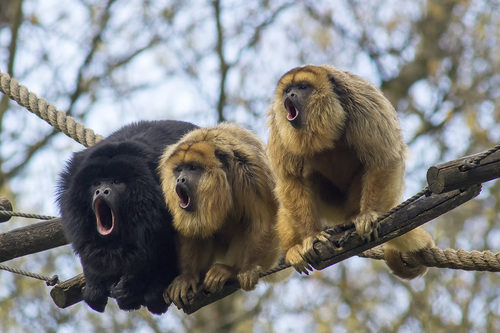
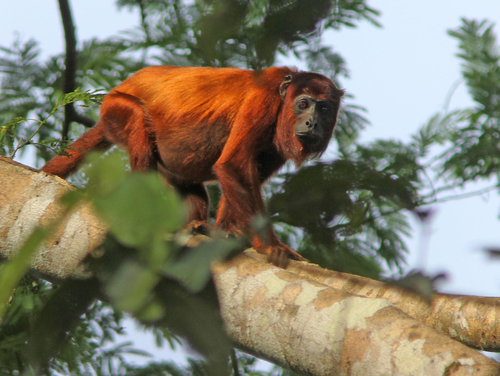
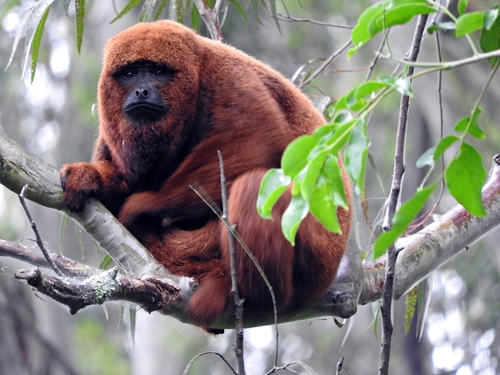
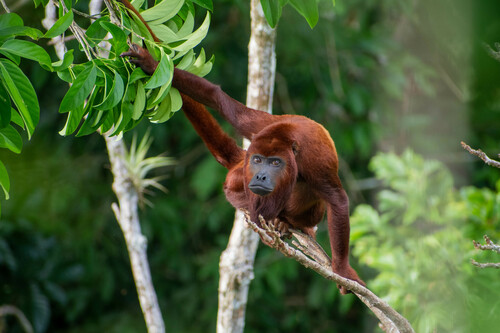
Alouatta seniculus, the red howler monkey, displays only slight sexual dimorphism. Males measure 49 to 72 cm in body length and weigh between 5.4 and 9 kg, while females measure 46 to 57 cm in body length and weigh 4.2 to 7 kg. This species has a long prehensile tail that ranges from 49 to 75 cm in length. The entire tail is covered in fur except for the underside of its last third, an adaptation that lets the monkey grab onto branches. Both sexes have a deep reddish-brown pelage, and the shade of this color changes as individuals age. Their faces are framed by fur, and they have stubby noses. The red howler monkey has a large jawbone, particularly the body of the mandible. The foramen magnum is positioned very far posteriorly to accommodate its expanded jaw and enlarged hyoid bone. It also has an inflated bulla, the bony structure that encloses the middle ear, which makes it unusual among other New World monkeys. Alouatta seniculus is a diurnal, arboreal primate that spends most of its time high in forest canopies. It prefers to move via quadrupedal walking, and leaping is rare. Its long prehensile tail assists movement by providing both support and additional grasping ability. Its hands and feet also have a grasping structure suited for moving through trees, visible in the wide separation between the second and third digits of the hand. Unbalanced sex ratios create fierce sexual competition between males of this species. To initiate mating, a female attracts males by moving her tongue; if a male does not respond, she will move on to mate with another male. The average gestation period for Alouatta seniculus is 190 days. Infants stay with their mothers for 18 to 24 months. Once males reach sexual maturity, they are driven out of their natal group. Mature males must then invade an unrelated foreign group, where they kill the existing group leader and all offspring sired by that leader. This behavior eliminates potential future competition for the invading male. Less than 25% of existing offspring survive these male invasions of social groups.