About Alouatta palliata (Gray, 1849)
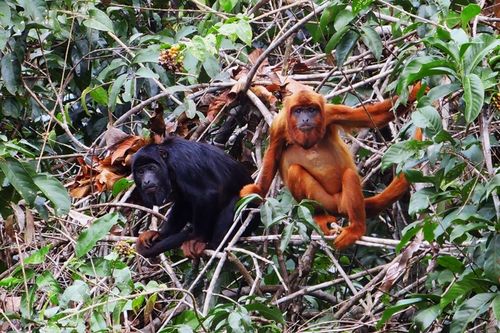
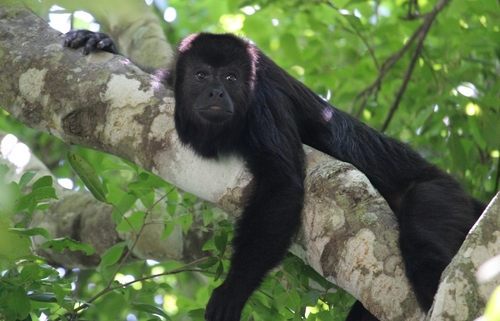
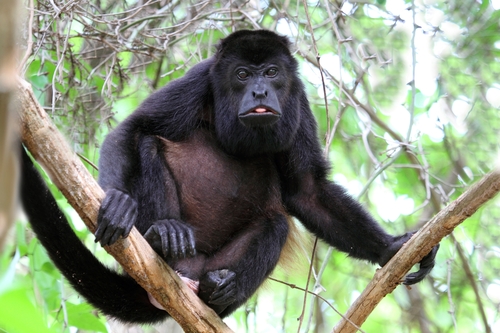
The mantled howler, scientifically named Alouatta palliata (Gray, 1849), shares a similar overall appearance with other howler monkeys in the genus Alouatta, and differs primarily in coloration. Its body is mostly black, with a fringe of yellow or golden brown guard hairs along its flanks; this feature gives the species its common "mantled" name. When males reach maturity, their scrotum turns white. Excluding the tail, female body length ranges from 481 to 632 mm (18+7⁄8 to 24+7⁄8 inches), while male body length ranges from 508 to 675 mm (20.0 to 26.6 inches). Its prehensile tail measures between 545 and 655 mm (21.5 to 25.8 inches) in length. Adult females generally weigh between 3.1 and 7.6 kg (6+7⁄8 to 16+3⁄4 pounds), and adult males typically weigh between 4.5 and 9.8 kg (9 pounds 15 ounces to 21 pounds 10 ounces). Average body weight can vary significantly between populations from different locations. The brain of an adult mantled howler weighs around 55.1 g (1+15⁄16 ounces), which is smaller than the brain of several smaller monkey species, such as the white-headed capuchin. Like other howler monkey species, the mantled howler has specific adaptations that support its folivorous diet, which consists of a large proportion of leaves. Its molars have high shearing crests that help process leaves, and males have an enlarged hyoid bone near the vocal cords. This bone amplifies males' calls, allowing them to locate other males without expending much energy. The mantled howler is native to Colombia, Costa Rica, Ecuador, Guatemala, Honduras, Mexico, Nicaragua, Panama and Peru. Within Honduras, Nicaragua, Costa Rica and Panama, it is found across most areas of these countries. In Colombia and Ecuador, it occupies a narrow corridor that borders the Pacific Ocean to the west and the Andes Mountains to the east; there is also a small population of the species in Colombia in a Caribbean coastal area near the Panama border. In Guatemala, it lives across the central part of the country, and extends into southeastern Mexico, south of the Yucatán Peninsula. It is among the most commonly seen and heard primates in many Central American national parks, including Manuel Antonio, Corcovado, Monteverde and Soberania. It can live in several different forest types, including secondary forest and semi-deciduous forest, but occurs at higher densities in older forest areas and regions with evergreen forest. Over a small portion of its range in Guatemala and Mexico near the Yucatan Peninsula, it is sympatric with another howler monkey species, the Guatemalan black howler, A. pigra. Mantled howlers have a polygamous mating system, where one male mates with multiple females. Usually, the group's alpha male monopolizes all breeding opportunities. However, if the alpha male is distracted, lower-ranking males can sometimes mate, and lower-ranking males get regular mating opportunities and sire offspring in some groups. Alpha males typically hold their status for 2+1⁄2 to 3 years, during which they may father around 18 infants. Females reach sexual maturity at 36 months old, while males reach sexual maturity at 42 months old. Females usually give birth to their first infant when they are 42 months old. Females experience regular estrus cycles, with an average duration of 16.3 days, and show visible changes to their sexual skin, most notably swelling and a color change from white to light pink of the labia minora. Mating begins when a receptive female approaches a male and performs rhythmic tongue flicking. The male responds with the same tongue movements, after which the female turns and elevates her rump to allow mating to start. Females also appear to use chemical signals, as males smell females' genitals and taste their urine. The gestational period is 186 days, and births can happen at any time of year. Newborn infants have silver fur, which turns pale or gold after a few days. The fur then gradually darkens, and infants develop full adult coloration at around 3 months old. For the first 2 to 3 weeks of life, the infant clings to its mother's chest and is carried underneath her. After this period, it is carried on the mother's back. At around 3 months old, the mother usually begins encouraging the infant to move independently, but will still carry it part of the time until it is 4 to 5 months old. After the young monkey can move on its own, the mother will still carry it across large, difficult gaps between trees. Juveniles spend much of their time playing with other juveniles. Infants are weaned at 1+1⁄2 years old, at which point maternal care ends. If a previous infant survives to weaning, adult females typically give birth every 19 to 23 months. Unlike other howler monkey species, male mantled howlers' testes do not descend until they reach sexual maturity. Upon reaching sexual maturity, most young monkeys are evicted from their natal group, though the offspring of high-ranking females may be allowed to stay. Many infants do not survive to sexual maturity: high-ranking adults sometimes harass or kill the offspring of lower-ranking monkeys to eliminate competition for their own offspring when they reach maturity. Both sexes leave their natal group; 79% of all males and 96% of all females emigrate from their original social group. When an outside male ousts the existing alpha male, he normally kills all existing infants in the group, so that the mothers quickly enter estrus and can mate with him. Predators including cats, weasels, snakes and eagles also kill infants. As a result, only around 30% of mantled howler infants live longer than one year. Middle-ranking females have the highest reproductive success, while alpha females have lower success, likely due to competitive pressures. Infant mortality is also lower when multiple females in a group give birth around the same time. If an individual survives infancy, it typically has a lifespan of 25 years. Tool use has never been observed in mantled howlers, and no howler monkey species was recorded using tools prior to 1997. In 1997, however, a Venezuelan red howler (Alouatta seniculus) was reported to use a stick as a club to hit a Linnaeus's two-toed sloth (Choloepus didactylus) resting in its tree. This observation suggests that other howler species, including the mantled howler, may also use tools in ways that have not yet been documented.