About Alosa mediocris (Mitchill, 1814)
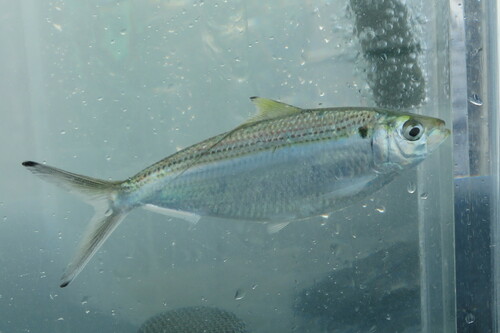
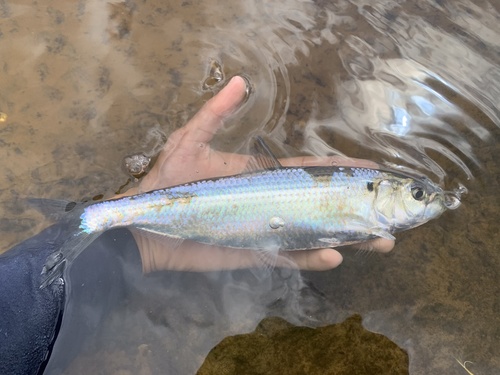
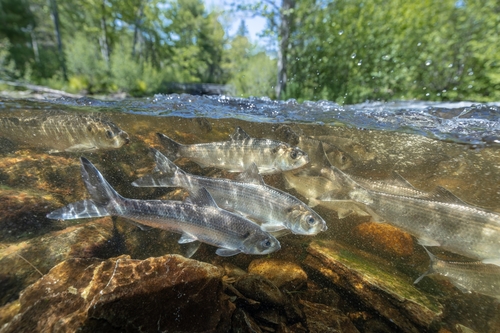
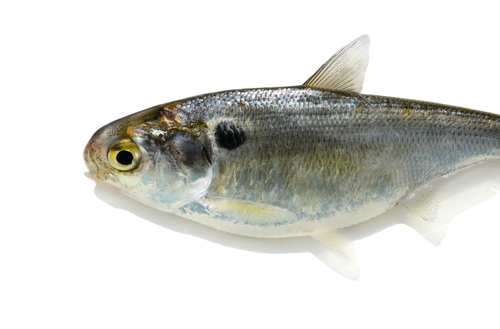
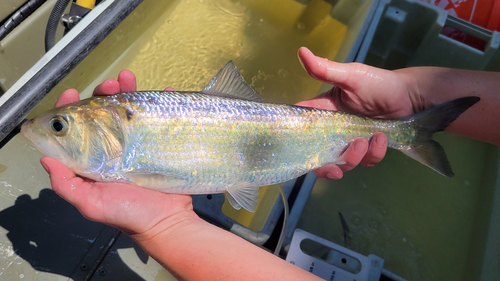
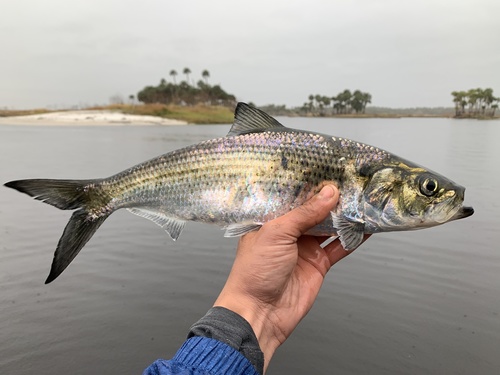
Hickory shad, with the scientific name Alosa mediocris (Mitchill, 1814), are elongate, laterally compressed fish with a tapering cross section. The scales on their bellies are serrated. Their upper surface is green-gray, shifting to iridescent silver on the sides and white on the underside. Their scales carry small dark markings, a humeral spot is present, and this spot is often followed by a short series of fainter spots. Hickory shad can be told apart from American shad by their lower jaw, which projects past the snout in hickory shad. Hickory shad range from northern Florida to the Gulf of Maine. The largest populations are found in Chesapeake Bay and coastal North Carolina. It is a schooling anadromous species that lives in marine waters, almost always not far from land. In spring, adult hickory shad enter estuaries and freshwater tributaries stretching from Florida's St. John's River to Maryland's Patuxent River to spawn. Their movements in the open ocean are poorly documented. Spawning takes place from December to June, starting earliest in Florida and occurring later at higher latitudes. Their eggs are slightly adhesive and demersal, around 1 mm in diameter, and appear to be scattered randomly over gravel bars in moderate currents. After the eggs harden in water, they become semibuoyant and develop while drifting along the bottom. A single female can produce between 43,000 and 475,000 eggs. While the developmental stages of eggs, larvae, and juveniles have been described, very little is known about the distribution, ecology, and growth rates of these early life stages. Hickory shad can live up to seven years. Both sexes reach maturity starting at 2 years of age, and individuals can spawn multiple times. Females are larger than males: in Florida, the average female has a fork length of 37 centimetres (15 in), while the average male has a fork length of 34 centimetres (13 in). Hickory shad are piscivorous, feeding mainly on small fish, though their diet also includes crustaceans and squid. One study conducted in Florida found that the diet of hickory shad on spawning grounds was almost entirely fish, making up 97% by weight. However, feeding is limited during freshwater migration, and mesenteric fat reserves built up before migration are broken down for energy along the route.