About Alosa aestivalis (Mitchill, 1814)
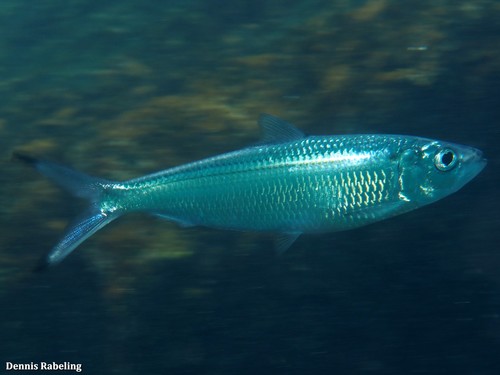
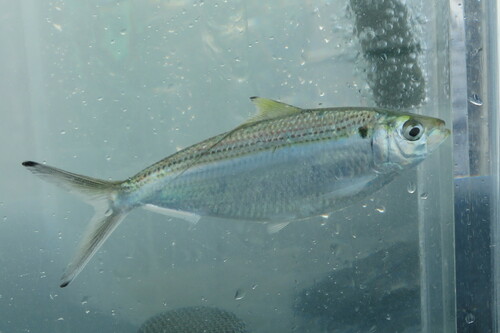
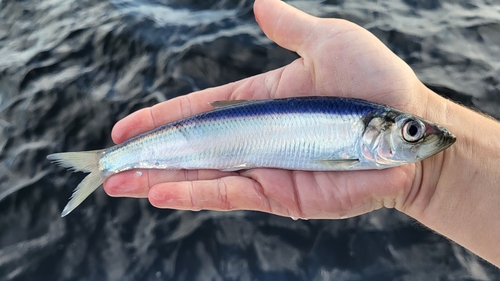
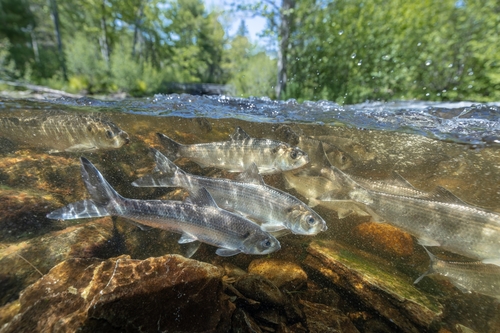
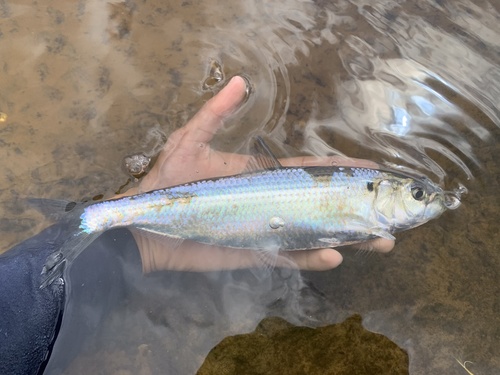
Blueback herring, also called blueback shad or summer shad, is an anadromous herring species native to the eastern coast of North America. Its native range stretches along the Atlantic Coast from Cape Breton, Nova Scotia, to the St. Johns River, Florida. It forms schools and is thought to migrate offshore to overwinter near the seabed. This fish is silvery overall, with deep bluish-green backs, and has a line of modified, spiny keeled scales called scutes along its belly. It reaches a maximum length of roughly 40 centimeters (16 inches) and is believed to live up to 8 years. The most distinct identifying feature of this species is the black to dusky color of its peritoneum, the membrane that lines the abdominal cavity. It counts among the "typical" North American shads. It is often confused with alewives, as the two species are hard to tell apart. Together, the two are commonly grouped and referred to collectively as "river herring". Unlike blueback herring, alewives have larger eyes, a deeper body, and pearly to white peritoneal linings. In the past, this species was used as baitfish for the lobster fishing industry. It is also consumed by humans, most commonly prepared smoked. It is caught during its upstream migration in shallow, narrow sections of migratory streams and rivers, where fishers use large dip nets to scoop individuals out of the water. During spawning season, blueback herring migrate into coastal rivers. As an anadromous species, it lives in marine habitats and spawns in deep, swift freshwater rivers with hard substrates. Spawning migration happens in spring. In Connecticut, blueback shad spawn in water between 14 and 17 °C (57 to 63 °F), usually later in spring than alewives. When spawning, many eggs are laid onto the stream bottom, where they adhere to gravel, stones, logs or other submerged objects. Juveniles remain in fresh water for three to seven months, after which they migrate out to the ocean. Blueback herring is a planktivorous forage species. Spawning occurs from late March through mid-May, varying with latitude. Females typically reach sexual maturity by age five, and produce between 60,000 and 103,000 eggs per individual. Males generally mature earlier, between 3 and 4 years of age, and are smaller than mature females. After spawning is complete, adult blueback herring migrate quickly back downstream. Little is known about their life history during their time in the marine environment, but they are thought to be capable of migrating long distances of over 1,900 kilometres (1,200 mi).