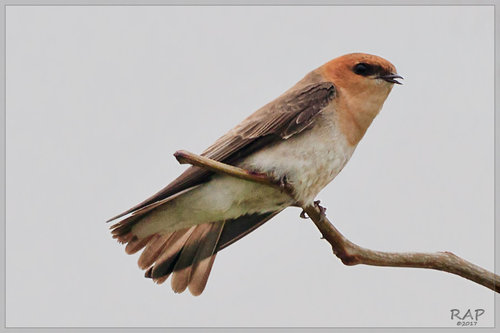
About Alopochelidon fucata (Temminck, 1822)
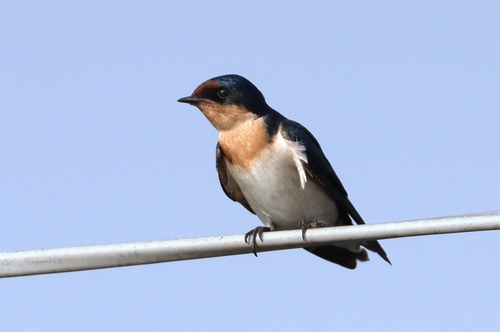
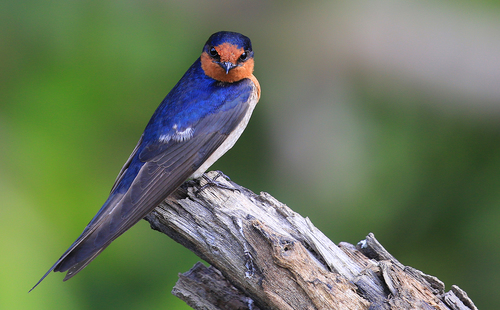
Alopochelidon fucata, commonly called the tawny-headed swallow, is a relatively small species. Adults typically measure 12 cm (4.7 in) in length and weigh 13–15 g (0.46–0.53 oz), and have a black bill that measures 6.6–8.1 mm (0.26–0.32 in) on average. Its crown is mostly brownish-black with tawny-rufous edges. The forehead, eyebrow, and hindcrown are tawny-rufous, transitioning into cinnamon-buff coloring on the ear coverts, sides of the head, throat, and breast. It has dark brown lores and brown irides. The remaining upperparts are gray-brown, with a paler rump. The wings and almost square tail are dark brown, while the underparts are dull white with pale gray-brown sides. Juveniles can be distinguished from adults by their more buff, less rufous head coloring, and their feathers have a buff tinge instead of a rufous tinge. The flight call of the tawny-headed swallow is a soft trilled treeeeb. This species is native to Argentina, Bolivia, Brazil, Colombia, Paraguay, Peru, Uruguay, and Venezuela, and is vagrant to Chile and the Falkland Islands. There are two separate resident populations of tawny-headed swallows: one located in southeast Venezuela, and the other in central and southern Brazil, eastern Bolivia, all of Paraguay except northwestern Paraguay, and northeast Argentina. Another resident breeding population occurs in Uruguay and part of central Argentina during the breeding season. It is unknown where this breeding population migrates in the non-breeding season, though non-breeding tawny-headed swallows have been sighted in eastern Colombia and southeastern Peru. Tawny-headed swallows inhabit open and mostly open tropical and subtropical areas, particularly near small bodies of water, forest clearings near streams, and pampas. They can also be found in wet or flooded areas of open grassland, and typically reside at altitudes up to 1,600 m (5,200 ft).