About Alopias vulpinus (Bonnaterre, 1788)
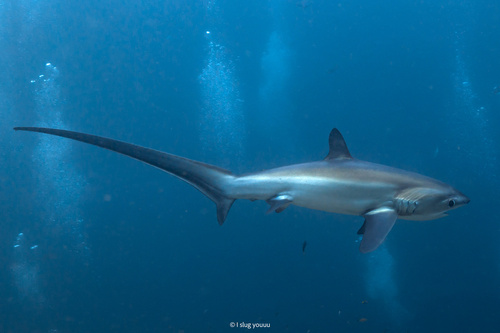
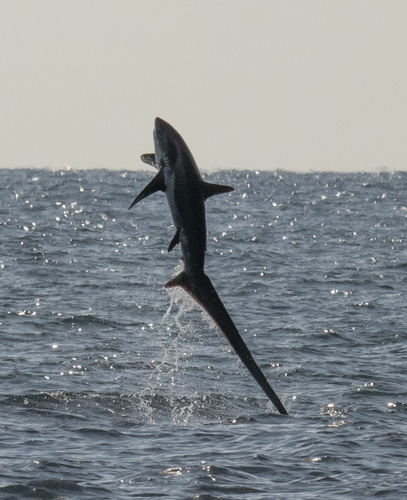
Alopias vulpinus, commonly known as the common thresher, is a fairly robust shark with a torpedo-shaped trunk and a short, broad head. The dorsal profile of the head curves evenly down to a pointed, conical snout. Its eyes are moderately large and lack nictitating membranes. The small mouth is arched, and unlike other thresher sharks, it has furrows at the corners. This species has 32–53 upper tooth rows and 25–50 lower tooth rows; the teeth are small, triangular, and smooth-edged, with no lateral cusplets. It has five pairs of short gill slits, with the fourth and fifth pairs positioned over the bases of the pectoral fins. The long, sickle-shaped (falcate) pectoral fins taper to narrowly pointed tips. The first dorsal fin is tall and sits slightly closer to the pectoral fins than to the pelvic fins. The pelvic fins are almost as large as the first dorsal fin; males bear long, thin claspers on these fins. The second dorsal and anal fins are very small, with the second dorsal fin located ahead of the anal fin. Crescent-shaped notches are present on the caudal peduncle at the upper and lower origins of the caudal fin. As is characteristic of threshers, the upper caudal fin lobe is enormously elongated, reaching about the same length as the rest of the shark; this thin, gently curving lobe is held at a steep upward angle and has a notch in the trailing margin near its tip. The skin is covered by small, overlapping dermal denticles, each with three horizontal ridges and three to five marginal teeth. This species is metallic purplish brown to gray on its upper side, becoming more bluish on the flanks. Its underside is white, and this white color extends over the pectoral and pelvic fin bases; this color pattern differs from the pelagic thresher, which has solid color over these fins. The dividing line between the dorsal and ventral coloration is often irregular. A white spot may sometimes be seen at the tips of the pectoral fins. The common thresher is the largest species of thresher shark, and commonly reaches 5 m (16 ft) long and 230 kg (510 lb) in weight. The confirmed maximum length record for this shark is 5.7 m (19 ft), while the maximum possible length may be 6.1–6.5 m (20–21 ft). The heaviest confirmed individual on record is a 4.8 m (16 ft) female that weighed 510 kg (1,120 lb). Unverified claims note that exceptional specimens may reach up to 900 kg (2,000 lb). The common thresher’s range covers tropical and cold-temperate waters worldwide. In the western Atlantic, it occurs from Newfoundland to the Gulf of Mexico (it is rare north of New England), and from Venezuela to Argentina. In the eastern Atlantic, it has been reported from the North Sea and the British Isles to Ghana (including Madeira, the Azores, the Mediterranean Sea, and the Black Sea), and also from Angola to South Africa. In the Indo-Pacific, this species is found from Tanzania to India and the Maldives, from Japan and Korea to southeastern China, Sumatra, eastern Australia, and New Zealand; it also occurs around several Pacific islands including New Caledonia, the Society Islands, Tabuaeran, and the Hawaiian Islands. In the eastern Pacific, it has been recorded from British Columbia to Chile, including the Gulf of California. The common thresher is migratory, moving to higher latitudes to follow warm-water masses. In the eastern Pacific, males travel further north than females, reaching as far as Vancouver Island in late summer and early fall. Juveniles tend to stay in warm nursery areas. In New Zealand waters, juveniles are found over the inner shelf around the North Island and around the upper South Island. Separate populations with different life history traits apparently exist in the eastern Pacific and western Indian Ocean, and possibly in other regions; this species is not known to make transoceanic movements. In the northwestern Indian Ocean, males and females segregate by location and depth during the January to May pupping season. Analysis of mitochondrial DNA has found substantial regional genetic variation among common threshers in all three oceans. This supports the idea that even though common threshers are highly mobile, sharks from different regions rarely interbreed. Common threshers live in both continental waters and the open ocean. They tend to be most abundant near land, especially juveniles, which frequent near-coastal habitats such as bays. The species is described as "coastal–oceanic", and mostly occurs within 30 km (20 mi) of the coast, with far lower population densities beyond that limit. Most individuals are found near the water surface, but the species has been recorded at depths of at least 550 m (1,800 ft). Among eight individuals tagged and tracked for 22–49 hours off southern California, all spent most of their time within 40 m (130 ft) of the water surface, but periodically dove to much deeper depths; five of these individuals dove to around 100 m (330 ft) or more. A study from the tropical Marshall Islands found that common threshers mainly spend the day at depths of about 160–240 m (520–790 ft), where the water temperature is 18–20 °C (64–68 °F). Common threshers appear to prefer water temperatures between 16 and 21 °C (61 and 70 °F), but occasionally occur in water as cool as around 9 °C (48 °F). Common threshers are active, strong swimmers, and there are infrequent reports of them leaping completely out of the water. Like the fast-swimming sharks of the family Lamnidae, the common thresher has a strip of aerobic red muscle along its flank that can contract powerfully and efficiently for long periods. In addition, it has slow-oxidative muscles located centrally in its body and a blood vessel countercurrent exchange system called the rete mirabile ("wonderful net"), which allows it to generate and retain body heat. The temperature inside the red muscles of a common thresher averages 2 °C (3.6 °F) higher than the temperature of the surrounding seawater, though there is significant variation between individuals. Unlike pelagic and bigeye threshers, the common thresher does not have an orbital rete mirabile to protect its eyes and brain from temperature changes. Immature common threshers are preyed on by larger sharks. Aside from observations of killer whales feeding on common threshers off New Zealand, adult common threshers have no known natural predators. Parasites that have been documented from the common thresher include the protozoan Giardia intestinalis, the trematodes Campula oblonga (the common thresher is not the usual host for this species) and Paronatrema vaginicola, the tapeworms Acanthobothrium coronatum, Anthobothrium laciniatum, Crossobothrium angustum, Hepatoxylon trichiuri, Molicola uncinatus, Paraorygmatobothrium exiguum, P. filiforme, and Sphyriocephalus tergetinus, and the copepods Dinemoura discrepans, Echthrogaleus denticulatus, Gangliopus pyriformis, Kroeyerina benzorum, Nemesis aggregatus, N. robusta, N. tiburo, Nesippus orientalis, and Pandarus smithii.