About Alopias pelagicus Nakamura, 1935
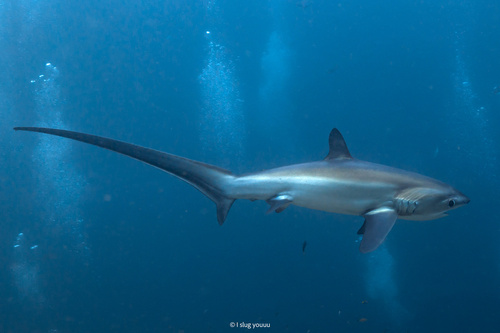
Alopias pelagicus, commonly known as the pelagic thresher, is the smallest species of thresher shark. Adults typically reach 3 m (10 ft) in length and 69.5 kg (153.2 lb) in weight, and usually do not exceed 3.3 m (11 ft) and 88.4 kg (195 lb). The maximum confirmed length for known males is 3.5 m (11 ft), while the maximum confirmed length for known females is 3.8 m (12 ft). An unconfirmed recorded length of 5 m (16 ft) is considered dubious, and likely stems from confusion with other thresher shark species. This species has a fusiform body, wide at the middle and tapered at both ends, plus a very slender upper caudal fin lobe that is nearly as long as the rest of the shark's body. Its pectoral fins are long, straight, and end in broad, rounded tips. The first dorsal fin sits halfway between the pectoral and pelvic fins, and is similar in size to the pelvic fins. Both the second dorsal fin and the anal fin are very small. The pelagic thresher has a narrow head with a short, conical snout, and a distinctive pinched profile when viewed from below. Juveniles have very large eyes, and the relative size of the eyes decreases as the shark ages. There are no furrows at the corners of the mouth. The shark's teeth are very small: the upper jaw holds 21–22 tooth rows on each side plus a central symphysial row, while the lower jaw holds 21 tooth rows on each side with no symphysial row. Between five and 11 rows of posterior teeth are present. The teeth have smooth edges, with oblique cusps and lateral cusplets on the outer margins. The shark's body is covered in very small, smooth dermal denticles that have flat crowns and cusps with parallel ridges. Pelagic threshers are colored an intense dark blue on their dorsal side and white on their ventral side; the white ventral coloration does not extend above the pectoral fins. This dark blue color quickly fades to gray after the shark dies. This species can be distinguished from the common thresher by its dark pigment above the pectoral fins, rounded pectoral fin tips, and lack of labial furrows. Because pelagic threshers have often been confused with common threshers, their actual distribution may be wider than currently documented. They have an extensive range across the Indo-Pacific, with scattered records from South Africa, the Red Sea, and the Arabian Sea (off Somalia, between Oman and India, and off Pakistan) east to China, southeastern Japan, northwestern Australia, New Caledonia, and Tahiti, and further east to the Hawaiian Islands, California, and the Galapagos Islands. The North Pacific population shifts northward during warm El Niño years. Mitochondrial DNA analysis has found extensive gene flow within eastern Pacific pelagic thresher populations and within western Pacific pelagic thresher populations, but little gene flow between the two regional groups. The pelagic thresher primarily lives in the open ocean, and occurs from the ocean surface down to a depth of at least 150 m (490 ft). It occasionally approaches close to shore in areas with a narrow continental shelf, and has been observed near coral reef dropoffs or seamounts in the Red Sea, the Gulf of California, off Indonesia, and off Micronesia. It has also been recorded entering large lagoons in the Tuamotu Islands. The pelagic thresher is an active, strong swimmer, and has been documented leaping completely clear of the water—on one occasion, five times in a row. Predators of this species include larger fishes, including other sharks, and toothed whales. Documented parasites of the pelagic thresher include three species of tapeworm in the genus Litobothrium (L. amplifica, L. daileyi, and L. nickoli), which live in the shark's spiral valve intestine, and copepods of the genus Echthrogaleus, which infest the shark's skin. At Malapascua Island in the Philippines, pelagic threshers have been observed regularly visiting cleaning stations run by two species of cleaner wrasse (Labroides dimidiatus and Thalassoma lunare). During these visits, the sharks display specific behaviors to make the cleaning interaction easier. Visits to cleaning stations happen more often early in the morning, and this behavior may explain why these normally open-ocean sharks are sometimes found in shallow water.