About Aloidendron dichotomum (Masson) Klopper & Gideon F.Sm.
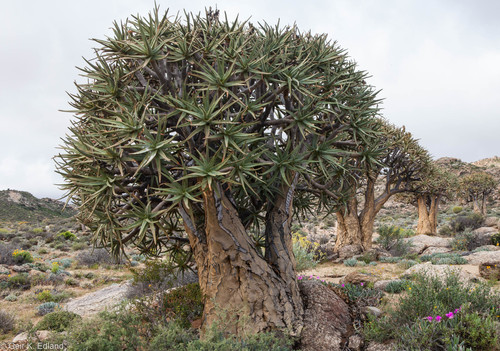
Aloidendron dichotomum (Masson) Klopper & Gideon F.Sm., formerly classified as Aloe dichotoma and commonly called the quiver tree or kokerboom, is a tall, branching succulent plant species. It is native to Southern Africa, occurring specifically in the Northern Cape province of South Africa and parts of southern Namibia. One of the only known naturally occurring spontaneous forests of this species is the Quiver Tree Forest, located approximately 14 km north of Keetmanshoop, Namibia. A second spontaneous forest is found at Gannabos in the Northern Cape of South Africa. Across most of the species' range, populations are declining. Modelling studies of Aloidendron dichotomum in South Africa and Namibia have helped improve understanding of protected area management needs in the context of climate change. Field surveys have recently confirmed the modelled range declines of this species caused by climate change. Aloidendron dichotomum is cultivated in arid regions worldwide for landscape gardening. Its slow growth rate and relative rarity make it a particularly expensive plant. It is also relatively difficult to maintain outside of its natural habitat. For successful cultivation, it requires extremely well-drained coarse mineral sand, preferably with added loam and bone meal to support active growth, along with full sun exposure, good aeration, and very limited water. Watering is primarily needed in winter, as the species naturally grows in winter rainfall desert areas. If the plant receives too little water (a rare occurrence), its leaves will curl and the leaf tips will die off; this condition is not fatal, but it signals that the plant is relatively dry. The species is unusually susceptible to aphids and insect infestations between its leaves, and this problem becomes worse when it does not receive full sun and constant fresh air movement. Plants grown indoors need frequent pest treatment for these issues. Fungicide can be applied occasionally to protect the plant from rot. It can be propagated from seed, and with more difficulty, from cuttings or truncheons. Cuttings must be dried thoroughly for several weeks in a shaded location before planting.