About Aloidendron barberae (Dyer) Klopper & Gideon F.Sm.
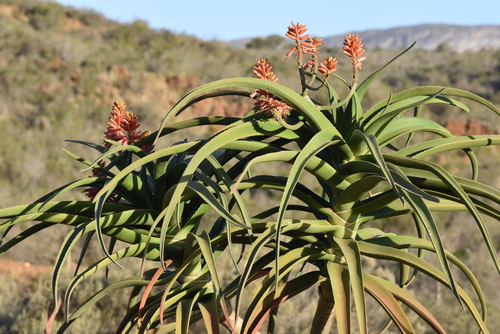
Aloidendron barberae (Dyer) Klopper & Gideon F.Sm. was formerly classified as Aloe bainesii and Aloe barberae, and is commonly called the tree aloe. It is a species of succulent plant in the genus Aloidendron. This species is native to areas from South Africa northward to Mozambique. In its native habitat, this slow-growing tree can reach up to 18 metres (59 ft) in height, with a stem diameter of up to 0.9 m (3 ft). Aloidendron barberae is Africa's largest aloe-like plant. It is commonly grown as an ornamental plant. Its flowers are tubular, rose pink with green tips, and it blooms in winter. In its natural environment, it is pollinated by sunbirds. The natural habitat of the tree aloe includes subtropical coastal forests, kloofs (ravines), and dry valleys in the eastern regions of southern Africa. It has a wide distribution ranging from the Eastern Cape, through KwaZulu-Natal, Eswatini, and Mpumalanga, northward to Mozambique and East Africa. In cultivation, Aloidendron barberae makes a striking focal point in gardens, growing into a large sculptural tree with a neat crown. One specimen planted at Kirstenbosch Botanical Garden in Cape Town in 1922 had reached a basal diameter (not girth) of 3 m (9.8 ft) by 2011. It propagates easily, especially from cuttings called truncheons; cuttings should be left to dry for one to two weeks before planting. It prefers well-drained soil, especially on a slope, and can tolerate some shade when young. It should not be planted between buildings or in locations where its roots will be confined, as its trunk and roots need space to expand and spread.