About Aloiampelos commixta (A.Berger) Klopper & Gideon F.Sm.
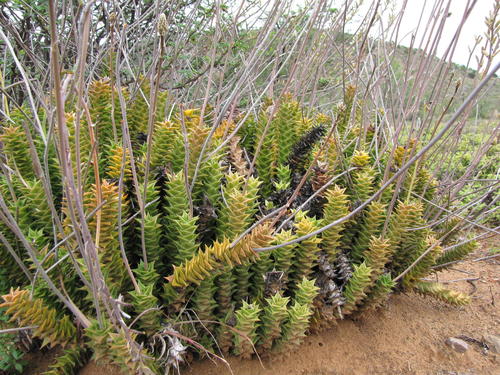
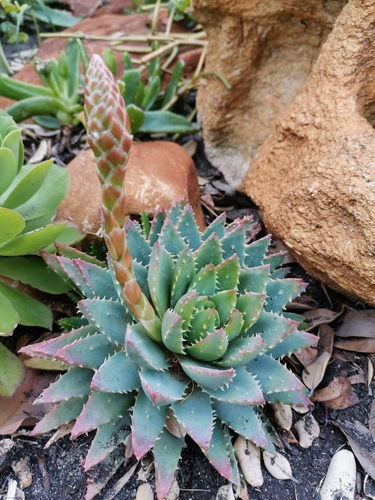
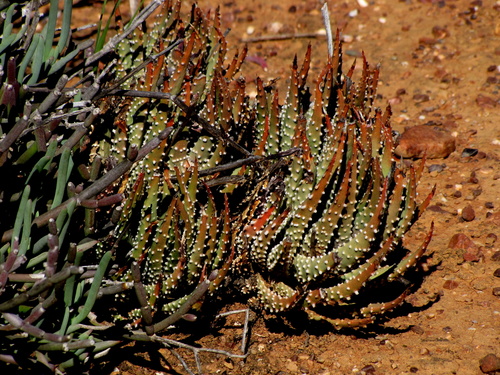
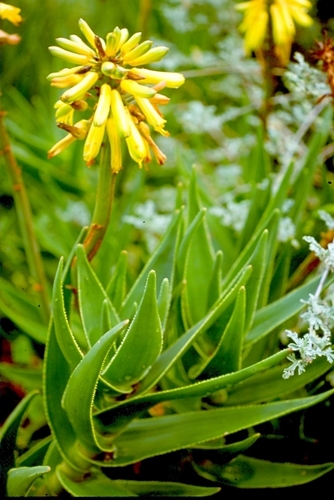
Aloiampelos commixta (A.Berger) Klopper & Gideon F.Sm., commonly known as the Peninsula rambling aloe, is a rambling, multi-stemmed accent plant. It rarely grows taller than 1 metre (3.3 ft), because its slender stems typically sprawl along the ground and over rocks. It flowers in late winter, during August and September. A stout inflorescence emerges, carrying reddish erect buds that open into dense, bright orange-yellow flowers. In its natural fynbos vegetation habitat on Table Mountain, its flowers are pollinated by sunbirds and honey bees. Its thick, fleshy leaves are evenly spaced along a fine stem, with distinctive green stripes on the internodes. Leaves are typically around 200 mm long, with tiny white teeth along their margins. This species can be easily identified by its straight, wide succulent leaves that do not recurve downwards, unlike the leaves of many other Aloiampelos species; its slender, sprawling stems; and its unique, distinguishing subcapitate flower raceme. In particular, its flowers are much larger than those of other species in the genus, and are grouped more densely at the top of the raceme. This aloe relative is a unique species indigenous and endemic to the Cape Peninsula, making it native specifically to Cape Town. Within its small natural range, it is concentrated most heavily in the central region of the Peninsula, in the area around Kommetjie, Kalk Bay, Fishhoek, Simonstown and Miller's Point, though smaller outlying populations exist elsewhere in the Table Mountain chain. It is one of only three aloes and their relatives that are indigenous to the city of Cape Town; the other two are the fynbos aloe and the soap aloe. It is very hardy in its natural habitat, and survives both frost and fire. Other species in its genus include the large, robust Aloiampelos striatula from Eastern Cape mountains, and Aloiampelos juddii, a rare small species confined to a few rocky outcrops on a farm near Cape Agulhas. This species is perfectly adapted to the winter-rainfall climate of the Cape, where it grows naturally. It is therefore difficult to cultivate outside of mediterranean-type climates, and does not thrive in tropical or summer-rainfall areas. It can grow in most soil types, with the exception of coastal beach sand dunes. In its natural habitat, it typically grows in slightly acidic sand. Unlike most members of the tribe Aloeae, it can tolerate some light semi-shade. Well-adapted to the Cape Town climate, it grows very well in Cape Town gardens, and looks attractive when sprawling over stonewall terraces, or rambling over rocky slopes and boulders. It produces striking, bright orange or yellow flowers in winter. This makes it a useful ornamental plant that adds color to gardens at a time of year when most other plants are not flowering. When sprawling stems become too long and unkempt, it is best to prune the plant back completely; this pruning simulates the effects of natural veldfires in its native habitat. After pruning, the plant will re-grow denser and bushier than before, and cuttings from this valuable plant can be re-planted or given to plant collectors. Cuttings called truncheons are also the easiest method to propagate Aloiampelos commixta. Allow cuttings to dry for a few days, then simply insert them into sandy soil. Each individual plant of this species produces both male and female flowers, but an individual plant is not self-fertile. Seeds germinate in semi-shade, in cool (25–35 °C), well-drained, slightly acidic sand. This plant was known and used medicinally by the Khoi, the oldest known inhabitants of the Cape. Later, it was one of the first plants cultivated by the Dutch East India Company in its Company's Gardens. The compounds thought to give the plant its medicinal properties are aloin from the sap, plus complex polysaccharides and glycoproteins from the pulp.